How Many Times Should You Train Each Muscle per Week?
How many times should you train each muscle per week to build muscle?
For many beginners and intermediate lifters, training each muscle around twice per week is an excellent starting point. But twice per week is not a magic number.
A muscle can grow when trained once, twice, three times, or even more often per week. When weekly training volume is similar, simply increasing frequency appears to have little independent effect on hypertrophy. The main benefit of training a muscle more often is that it helps you spread your sets more effectively, maintain workout quality, and manage fatigue.
So instead of only asking:
“How often should I train this muscle?”
a better question is:
“How should I distribute the volume this muscle needs across the week?”
Training Frequency and Volume Are Not the Same Thing
Training frequency refers to how many times a muscle is trained during the week.
Volume refers to the total amount of work performed.
Imagine two people both doing 12 weekly sets for the chest.
The first performs all 12 sets in one workout.
The second performs six sets in one session and another six a few days later.
Training frequency increased from once to twice per week, but total weekly volume stayed the same.
This distinction matters because when a program increases frequency and volume at the same time, it becomes difficult to determine which variable actually caused the difference in results.
What Changes When Weekly Volume Is Matched?
For hypertrophy, current evidence suggests that training frequency itself has a relatively small effect when weekly volume is matched.
A 2019 meta-analysis found similar muscle-growth outcomes between higher and lower training frequencies when the groups performed comparable weekly volume.
A more recent meta-regression published in 2026 reached a similar conclusion. Weekly volume showed a clearer relationship with hypertrophy, while the independent effect of frequency was compatible with being small or negligible.
That does not make frequency useless.
It makes frequency a programming tool.
You can use it to:
- Spread weekly volume across multiple workouts;
- Avoid excessively long sessions;
- Maintain higher-quality sets;
- Improve recovery between sessions;
- Practice exercises more often;
- Give certain muscles more attention;
- Fit training into your schedule more effectively.
This is why twice per week works extremely well in practice, even though your muscles do not biologically require exactly two training sessions every seven days.
Why Can Spreading Volume Across More Sessions Help?
The more sets you pack into one workout, the more fatigue tends to accumulate.
Toward the end of a long session, you may lose:
- Repetitions;
- Load;
- Technique;
- Stability;
- Range of motion;
- Ability to produce high-quality effort.
Imagine that you want to perform 16 weekly sets for one muscle.
Doing all 16 in one workout can work, but splitting them into two sessions of eight may allow you to perform the later sets with better quality.
In some situations, three smaller sessions may be even more convenient.
There is no universal per-session set limit that applies to everyone.
The important principle is simple:
If the quality of your later sets drops significantly, distributing your weekly volume across more sessions may be better than continuing to pile work into one workout.
How Long Does a Muscle Need to Recover?
There is no universal rule saying every muscle needs exactly 48 or 72 hours before it can be trained again.
Recovery depends on factors such as:
- Training volume;
- Proximity to failure;
- Exercise selection;
- Training experience;
- Sleep;
- Nutrition;
- Psychological stress;
- Muscle damage;
- Your previous training history.
A short biceps workout does not create the same recovery demand as a difficult lower-body session.
A more useful practical question is whether you can return to the next workout with performance that is close to or better than expected.
If a higher training frequency repeatedly causes your load, repetitions, or technique to decline, the issue may be insufficient recovery, excessive weekly volume, or poor distribution of training stress.
Muscle soreness is not a perfect recovery timer either.
You can still feel some DOMS and perform well, or feel no soreness at all while still carrying fatigue.
How Often Should You Train Each Muscle for Hypertrophy?
Once per Week
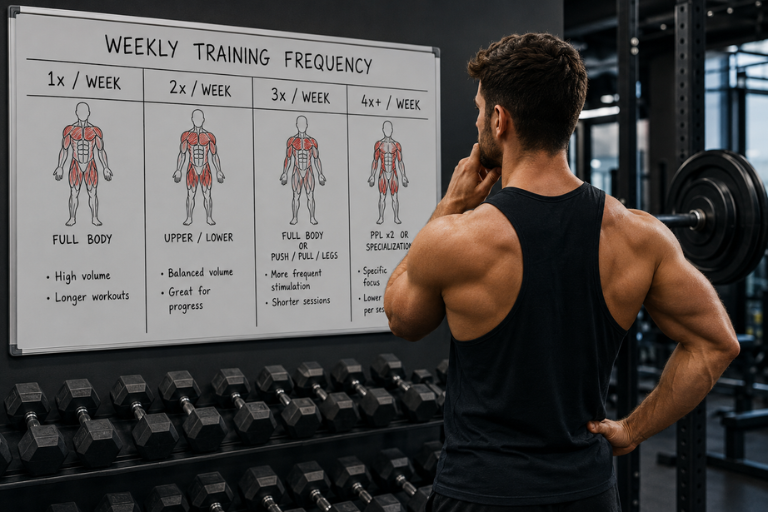
Training a muscle once per week can work.
If weekly volume is sufficient and your sets are performed well, hypertrophy can occur with a single weekly session.
The main limitation is that larger amounts of volume have to be concentrated into one workout, which can reduce the quality of later sets.
Twice per Week
For many beginners and intermediate lifters, this is probably the most practical starting point.
Training a muscle twice per week allows you to distribute volume without making the program unnecessarily complicated.
For example, 12 weekly sets can become six sets in one session and six in another instead of doing all 12 at once.
Three Times per Week
Training a muscle three times per week can also work very well.
It is especially useful in full-body programs, specialization phases, or for people who prefer shorter training sessions.
Increasing frequency does not mean repeating the same amount of work every time.
The goal is to distribute volume, not multiply it.
Four or More Times per Week
Higher frequencies can make sense for technical practice, specialization, or programs with very low volume per session.
The more often you train a muscle, the more important it becomes to control the amount of work performed each time.
Is Training Frequency Different for Strength?
To some extent, yes.
For hypertrophy, frequency appears to have relatively little independent effect when weekly volume is equal.
Strength has an additional component: specific practice of the movement itself.
If you want to improve your bench press, you are not only developing your chest, triceps, and shoulders.
You are also practicing:
- Coordination;
- Technique;
- Bar path;
- Stability;
- Producing force in that specific movement.
The 2026 meta-regression found a more consistent relationship between training frequency and strength gains, although the benefits also showed diminishing returns.
An earlier meta-analysis also found a general advantage for higher frequency, but the difference became smaller when total training volume was matched.
So higher frequency may help strength by providing both better volume distribution and more opportunities to practice the lift.
Do Beginners, Intermediate Lifters, and Advanced Lifters Need the Same Frequency?
Beginners often benefit from two or three weekly exposures because they are not only stimulating the muscles—they are also learning technique, range of motion, and control.
Intermediate lifters typically accumulate more training volume and use heavier loads. Training each muscle around twice per week is often a convenient way to distribute that work.
Advanced lifters do not automatically need higher frequency. Some benefit from more sessions to spread out volume, while others need more recovery between demanding workouts.
The more experienced you become, the more useful your own training history becomes compared with a generic rule.
It is also much easier to judge whether your frequency is working when you can compare actual workouts instead of relying on memory.
Organize your workouts, record your sets, repetitions, and loads, and track your progress with BestialFit Ascend. You can sign up for free and start logging your training.
Click the link below to access BestialFit Ascend and create your free account:
Do Smaller Muscles Need to Be Trained More Often?
Not necessarily.
Muscles such as the biceps, triceps, and deltoids already receive considerable indirect work from compound exercises.
Pressing movements involve the triceps and anterior deltoids.
Rows and pulldowns involve the biceps and other elbow flexors.
So when thinking about frequency, consider meaningful training exposure, not only the days where you perform an isolation exercise specifically named after that muscle.
How to Organize Training Frequency With 2 to 6 Training Days
Your workout split is simply a way to organize the work.
2 Days per Week
A full-body workout on both days is one of the simplest options.
This gives the major muscle groups roughly two weekly exposures.
3 Days per Week
Full body three times per week works very well, especially for beginners.
You can also organize the muscles differently across those three days depending on your goals and preferences.
4 Days per Week
An upper/lower split is a practical option:
- Two upper-body sessions;
- Two lower-body sessions.
This gives most major muscle groups approximately two direct exposures each week.
5 or 6 Days per Week
With five training days, you can combine general sessions with more specialized workouts or give priority muscles an additional weekly exposure.
With six days, a repeated Push/Pull/Legs structure is a common example:
- Push;
- Pull;
- Legs;
- Push;
- Pull;
- Legs.
This usually gives many muscle groups around two direct weekly exposures.
None of these splits is automatically superior.
A 2024 meta-analysis comparing full-body and split routines found similar outcomes for hypertrophy and strength when weekly volume was matched.
The best structure is the one that allows you to perform enough high-quality training consistently.
When Should You Increase Training Frequency?
Increasing frequency can be useful when:
- Your workouts are becoming too long;
- Your later sets are losing quality;
- You want to increase volume for a specific muscle;
- You need more practice with a particular exercise;
- A muscle has become a priority;
- Your schedule favors shorter, more frequent workouts.
Instead of turning a 12-set chest session into an 18-set marathon, it may be more practical to move some of that work into a third weekly exposure.
When Should You Reduce Training Frequency?
Consider reducing or reorganizing your training frequency if:
- Performance consistently drops in the following session;
- Technique deteriorates;
- Fatigue remains high between workouts;
- Too many muscles receive overlapping stress;
- Your routine becomes difficult to maintain.
Training more frequently does not automatically make a program more advanced.
The best program is one you can perform, recover from, and continue progressing on.
Common Mistakes When Choosing Training Frequency
Treating Twice per Week as a Rule
It is an excellent practical guideline, not a physiological requirement.
Increasing Frequency and Volume at the Same Time
If you previously performed ten sets once per week and then start doing ten sets three times per week, you did not simply increase frequency.
You tripled your weekly volume.
Ignoring Indirect Training
Your triceps work during pressing exercises.
Your biceps work during rows and pulldowns.
This affects the true number of times those muscles are stimulated each week.
Choosing a Split Before Deciding What Work You Need
“I want to run PPL” should not necessarily be the first step in program design.
First determine:
- How many days you can realistically train;
- How much volume you need to distribute;
- Which muscles are priorities.
Then choose the split that fits those needs.
Quick Takeaways
- Training each muscle twice per week is an excellent starting point for hypertrophy;
- It is not a magic number;
- When weekly volume is matched, higher frequency appears to have little independent effect on muscle growth;
- Frequency is mainly useful for distributing volume, preserving set quality, and managing recovery;
- Once per week can work;
- Three or more times per week can also work;
- Higher frequency usually means less work per session;
- For strength, frequency may offer additional benefits through more specific practice;
- Beginners often benefit from two or three weekly exposures;
- Consider indirect work when evaluating smaller muscles;
- Choose your split based on volume, recovery, priorities, and availability.
Frequently Asked Questions
Is It Better to Train Each Muscle Two or Three Times per Week?
For hypertrophy, training three times per week does not appear to be automatically better than twice per week when total weekly volume is similar.
Three sessions can still be useful for distributing higher volumes or prioritizing a specific muscle.
Can Training a Muscle Once per Week Still Build Muscle?
Yes.
Muscle growth can occur with one weekly session when volume and set quality are sufficient.
The main drawback is having to concentrate all of that work into one workout.
Can I Train the Same Muscle on Consecutive Days?
It can work in some programs, especially when each session uses low volume or different types of stress.
If performance declines because you are not recovering, the schedule should be adjusted.
Do I Have to Wait 48 Hours Before Training the Same Muscle Again?
No.
There is no universal 48-hour rule.
Recovery depends on the workout, the muscle, and the individual.
Is Full Body Better Than Push/Pull/Legs?
Not necessarily.
When training volume is matched, full-body and split routines can produce similar results for muscle growth and strength.
Choose based on your schedule, preference, and ability to distribute training effectively.
What Frequency Is Best for a Lagging Muscle?
Adding a third weekly exposure can be useful if it allows you to distribute extra volume without creating an excessively long session.
But the additional frequency only helps if recovery and set quality remain adequate.
Conclusion
How many times should you train each muscle per week?
For many beginners and intermediate lifters, twice per week is an excellent starting point.
But not because your muscles require exactly two training sessions every seven days.
When weekly volume is matched, training frequency appears to have relatively little independent effect on hypertrophy.
Its real value is in helping you distribute your workload, maintain set quality, manage fatigue, and fit training into your life.
So do not choose your workout split simply to hit a magic frequency number.
Decide how much work you can perform and recover from, distribute that volume throughout the week, and monitor your performance.
Want to know whether your current training frequency is actually working? Sign up for free on BestialFit Ascend, log your workouts, sets, repetitions, and loads, and compare your progress across the weeks.
Click the link below to access BestialFit Ascend and create your free account:
The best training frequency is the one that allows you to do enough productive work, recover from it, and keep progressing.
References
- Pelland JC, Remmert JF, Robinson ZP, Hinson SR, Zourdos MC. The Resistance Training Dose Response: Meta-Regressions Exploring the Effects of Weekly Volume and Frequency on Muscle Hypertrophy and Strength Gains. Sports Medicine. 2026;56(2):481–505. DOI: 10.1007/s40279-025-02344-w. PMID: 41343037.
- Schoenfeld BJ, Grgic J, Krieger JW. How many times per week should a muscle be trained to maximize muscle hypertrophy? A systematic review and meta-analysis of studies examining the effects of resistance training frequency. Journal of Sports Sciences. 2019;37(11):1286–1295. DOI: 10.1080/02640414.2018.1555906. PMID: 30558493.
- Grgic J, Schoenfeld BJ, Davies TB, Lazinica B, Krieger JW, Pedisic Z. Effect of Resistance Training Frequency on Gains in Muscular Strength: A Systematic Review and Meta-Analysis. Sports Medicine. 2018;48(5):1207–1220. DOI: 10.1007/s40279-018-0872-x. PMID: 29470825.
- Ramos-Campo DJ, Benito-Peinado PJ, Andreu-Caravaca L, Rojo-Tirado MA, Rubio-Arias JÁ. Efficacy of Split Versus Full-Body Resistance Training on Strength and Muscle Growth: A Systematic Review With Meta-Analysis. Journal of Strength and Conditioning Research. 2024;38(7):1330–1340. DOI: 10.1519/JSC.0000000000004774. PMID: 38595233.
- Currier BS, D’Souza AC, Fiatarone Singh MA, et al. American College of Sports Medicine Position Stand. Resistance Training Prescription for Muscle Function, Hypertrophy, and Physical Performance in Healthy Adults: An Overview of Reviews. Medicine & Science in Sports & Exercise. 2026;58(4):851–872. DOI: 10.1249/MSS.0000000000003897. PMID: 41843416