Resistance Profiles in Weight Training: Why Exercises Get Harder at Different Points
Two exercises can train essentially the same muscle and still feel completely different during execution.
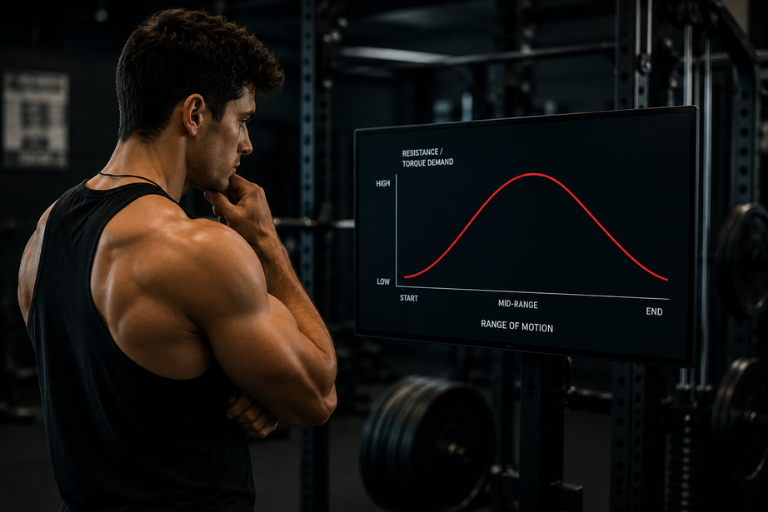
In one movement, the greatest challenge may appear at the beginning of the repetition. In another, it may occur in the middle. In a third, the exercise may gradually become easier as you approach the end of the range of motion.
This is not accidental.
The explanation is largely found in the resistance profile: the way external resistance creates demand on a joint and its muscles throughout the range of motion.
Understanding this concept can help you choose exercises more intelligently, combine complementary movements, and understand why certain parts of a repetition feel much harder than others.
However, there is an important point to avoid: a resistance profile does not allow you to create a universal ranking of the “best exercises.” Biomechanics depend on the exercise, equipment, technique, individual anatomy, and training goal.
What Is a Resistance Profile?
A resistance profile describes how the mechanical difficulty of an exercise changes throughout its range of motion.
Imagine a dumbbell curl.
The weight of the dumbbell remains essentially constant. However, that does not mean the biceps faces exactly the same demand throughout the entire repetition.
As the forearm changes its position relative to gravity, the relationship between the external force and the elbow joint also changes.
Consequently, some positions may require more muscular torque than others.
That is why an exercise can have:
- a relatively easy starting position;
- a very difficult middle portion;
- and an easier final portion.
The weight itself did not necessarily change.
The mechanics of the position changed.
External Force, Moment Arm, and Torque
To understand resistance profiles, three concepts are particularly useful: external force, moment arm, and torque.
External force is the force applied by the resistance to the system. In a dumbbell curl, for example, gravity applies force to the dumbbell.
The moment arm is the perpendicular distance between the line of action of that force and the axis of the joint.
The resulting external joint torque depends on these factors.
In simplified form:
Torque = force × moment arm
This explains why the same weight can create different demands at different positions.
If the moment arm increases, external torque also increases, even if the load remains exactly the same.
This is why simply looking at the weight being used is not enough to understand the difficulty of an exercise.
Resistance Profile Is Not the Same as the Strength Curve
There is another important concept: the strength curve.
The strength curve represents, in simplified terms, how your ability to produce force changes depending on the position and speed of a movement.
The resistance profile represents the demand imposed by the exercise.
These two curves are not necessarily the same.
This creates an interesting situation.
Imagine that an exercise becomes progressively harder while your ability to produce force decreases in that portion of the range of motion.
That region may become particularly limiting.
Conversely, if resistance is greater where you have a greater capacity to produce force, the exercise may feel more balanced.
Therefore, when analyzing an exercise, the question should not simply be:
“Which muscle does it train?”
A better question is:
“In which positions does this muscle have to produce the most torque against the resistance?”
Where Is the Hardest Point?
The hardest point of an exercise is often referred to as the sticking region or sticking point.
In the bench press, for example, there is a region where bar velocity can decrease substantially during a heavy repetition.
Biomechanical research shows that changes in technique, bar path, joint position, and joint moments can significantly alter the mechanics of the movement.
This helps explain why someone may move the bar away from the chest relatively easily but encounter a specific region where the repetition seems to “stick.”
It does not necessarily mean that the muscle responsible for the movement simply “became weaker.”
The difficulty may be related to the combination of:
- joint position;
- moment arm;
- muscular capacity in that position;
- coordination;
- stability;
- load trajectory;
- repetition velocity.
Dumbbells, Cables, and Machines Change the Resistance Profile
The equipment you use can substantially change how resistance acts on the body.
Dumbbells
With dumbbells, gravity determines the primary direction of resistance.
Therefore, the resistance profile depends heavily on the orientation of the body segments relative to gravity.
As a result, changing body position or exercise angle can substantially alter where the movement becomes hardest.
Cables
Cables allow you to change the direction of resistance.
This is one reason apparently similar exercises can have different resistance profiles when performed with a cable instead of free weights.
Changing pulley position, cable direction, or the path of the implement can change the line of action of the force and, consequently, the moment arms involved.
Machines
Machines can use mechanisms such as pulleys, levers, and cams to modify the relationship between load and movement.
This makes it possible to create specific resistance profiles.
A classic example is the leg extension. Experimental research shows that changing the resistance moment arm in a machine can modify the torque produced and performance during the exercise.
Therefore, it is not correct to assume that “machines” automatically mean constant resistance or that “cables” automatically provide a better-distributed resistance profile.
The specific mechanics of the equipment still need to be considered.
Bench Press: Why Does the Difficulty Change During the Repetition?
In the bench press, the primary resistance comes from gravity acting on the bar.
As the bar moves, shoulder and elbow angles change and, consequently, so do the moment arms involved.
This alters the relative contribution of the different joints.
The exercise also requires stabilization and coordination between multiple body segments.
Therefore, two people may use different bar paths and experience different joint demands while performing the same exercise.
Research involving recreational lifters and powerlifters has shown that training experience and sex can influence bench press technique, including bar path, joint range of motion, and joint moments.
This is a good demonstration of why we should not treat an exercise as though it has one universal biomechanical configuration.
Lateral Raises: Why Can the Middle Feel So Difficult?
The lateral raise is an intuitive example.
When the arms are close to the body, the perpendicular distance between the resistance and the shoulder joint is relatively small.
As the arms move away from the body, this relationship changes.
In certain positions, the external resistance can produce substantially greater torque around the shoulder.
This is one reason the middle portion of a lateral raise often feels much more demanding than simply starting the movement.
The weight being used may be small.
That does not mean the joint torque is also small.
External load and muscular demand are not synonyms.
Curls: Why Does the Hardest Point Change?
The biceps curl is another classic example.
With the elbow close to extension, the relationship between the forearm and gravitational force creates a particular demand around the elbow.
As the elbow flexes, that relationship changes.
The result is a resistance curve that is not uniform.
This is why some people can begin a repetition relatively easily, encounter a difficult region in the middle, and then complete the final portion more easily.
It also explains why changing equipment can alter how an exercise feels without necessarily changing the target muscle.
A dumbbell curl and a cable curl can have different resistance profiles.
Leg Extension: An Even Clearer Example
In the leg extension, resistance is transmitted through a lever connected to the lower leg.
The design of the machine can alter how the resistance moment arm changes throughout knee extension.
This is not merely a theoretical issue.
Experimental studies comparing different resistance mechanisms in leg extension machines have found meaningful differences in the torque produced by participants.
As a result, two machines that appear nearly identical may not create exactly the same mechanical experience.
This is one reason changing equipment can alter the difficulty of an exercise even when the load displayed on the machine appears similar.
How to Use Resistance Profiles When Choosing Exercises
The goal should not be to find an exercise that is “perfect” throughout the entire range of motion.
That would be an oversimplification.
A more useful approach is to look for complementarity.
Imagine two exercises for the same muscle.
The first produces greater demand in one region of the range of motion.
The second produces greater demand in another.
They may be more useful together than two exercises with almost identical resistance characteristics.
For example, if you choose two movements that become extremely difficult in exactly the same position, you may be repeating the same mechanical characteristic without realizing it.
Conversely, combining exercises with different profiles may distribute the demands more broadly.
This does not mean there is one universally superior combination.
The context of the training program still matters.
Can Resistance Profiles Help With Hypertrophy?
They can help you formulate better hypotheses about the stimulus produced by an exercise, but they should not be treated as standalone proof of greater hypertrophy.
An exercise producing greater torque in a particular position does not automatically mean it will produce more muscle growth.
Muscle growth depends on multiple factors, including volume, effort, frequency, range of motion, execution, recovery, and progression.
Recent research also reinforces that the relationship between muscle length, range of motion, and exercise selection is complex. Studies examining training at longer muscle lengths suggest possible advantages in certain contexts, but the evidence remains uncertain and heterogeneous.
Therefore:
Biomechanics helps explain the stimulus; it does not replace evidence of long-term adaptation.
What About EMG? Is an Exercise With More Activation Better?
Not necessarily.
Electromyography, or EMG, measures electrical signals associated with muscle activation.
It can be useful for investigating how certain muscles respond to a movement, but it should not be treated as synonymous with hypertrophy.
A muscle showing greater EMG activity during an exercise does not automatically mean that the exercise will produce more muscle growth.
The relationship between EMG and muscular force is also complex and can be influenced by factors such as normalization methods, reference contractions, and individual characteristics.
Therefore, a better framework is:
biomechanics + training evidence + individual progression
rather than:
“higher EMG = better exercise.”
Individual Anatomy Also Matters
There is no single resistance curve that is identical for everyone.
Segment lengths, body proportions, mobility, technique, and positioning can alter the mechanics of a movement.
This is especially evident in compound exercises.
In the bench press, for example, anthropometric and biomechanical differences are associated with force-producing capacity. Research indicates that factors such as joint moments, lean body mass, and individual characteristics contribute to differences in performance.
Therefore, two lifters may feel the same exercise in different regions or encounter different sticking points.
That does not necessarily mean one of them is performing the movement incorrectly.
How to Analyze Two Apparently Similar Exercises
You can use a simple five-question model.
1. What is the external resistance?
Is it gravity, a cable, a machine, or another form of resistance?
2. What is the direction of the resistance?
Where is the force being applied?
3. Which joint are you analyzing?
Identify the main joint responsible for the movement.
4. How does the moment arm change?
Look at which positions place the line of action of the resistance farther from the joint axis.
5. Where is the hardest point?
Then compare that point with the second exercise.
This process already provides a much more useful analysis than simply saying that both exercises “train the same muscle.”
Limitations of Visual Analysis
There is an important limitation: you cannot always determine an exercise’s resistance profile simply by watching a video.
A complete biomechanical analysis may require:
- anthropometric measurements;
- kinematics;
- external force measurements;
- segmental models;
- inverse dynamics;
- joint torque estimates;
- specific information about the equipment.
Furthermore, human movement involves multiple muscles and joints simultaneously.
A visual analysis can provide a useful hypothesis, but it is not necessarily an accurate measurement of the force produced by each muscle.
Therefore, statements such as “this exercise has maximum resistance here” should be treated cautiously when sufficient data are not available to support them.
Quick Glossary
Resistance profile: how the mechanical demand produced by external resistance changes throughout an exercise’s range of motion.
Moment arm: the perpendicular distance between the line of action of a force and the axis of a joint.
Torque: the tendency of a force to produce rotation around an axis.
Strength curve: how the ability to produce force changes according to position, velocity, or other conditions.
Sticking region: the portion of a repetition where velocity tends to decrease substantially and progressing the load becomes particularly difficult.
EMG: a technique that records electrical activity associated with muscle activation.
Inverse dynamics: a biomechanical method that uses movement and external forces to estimate joint moments.
How to Apply This to Your Training
You do not need to turn every workout into a biomechanics lecture.
Use the concept when facing a practical decision.
If two exercises seem very similar, ask whether they actually have the same resistance profile.
If a movement feels particularly difficult in one specific position, consider what is happening with the moment arm and joint angles.
If one machine feels very different from another, remember that the mechanism being used can alter the relationship between load and torque.
And most importantly, do not choose exercises simply because a muscle appears to be “more activated.”
The goal is to build a coherent selection of movements that allows you to train with good technique, progression, and recovery.
You can also use BestialFit Ascend as an organizational tool to keep your exercise library and training history structured, making it easier to compare exercises and track performance over time.
You can sign up for free:
Quick Takeaways
A resistance profile explains why an exercise can become harder in certain parts of the range of motion even when the external load remains constant.
The main mechanism involves the relationship between external force, moment arm, and joint torque.
Dumbbells, cables, and machines can produce different resistance profiles because they change the direction or application of resistance.
The lifter’s strength curve also matters: the point at which an exercise is hardest depends on the interaction between external demand and the ability to produce force in that position.
To choose exercises more intelligently, try to understand where each movement is most demanding and consider combining exercises with different characteristics.
But do not turn biomechanics into an exercise ranking system.
Greater torque in a particular position, higher EMG activity, or a stronger sensation of difficulty are not, by themselves, proof of greater hypertrophy.
The best application of this concept is to use biomechanics to ask better questions about your exercises and then determine, over time, whether those choices actually work within your program.
The next time two exercises seem almost identical, analyze their resistance, moment arm, and hardest point. You may discover that they are much more different than they appear.
Frequently Asked Questions
What Is a Resistance Profile in Weight Training?
It is the way the mechanical demand produced by resistance changes throughout an exercise’s range of motion.
Is a Resistance Profile the Same as a Strength Curve?
No. The resistance profile primarily represents the demand imposed by the exercise, while the strength curve represents how the ability to produce force changes according to position or other conditions.
Are Cables Better Than Dumbbells?
There is no universal answer. Cables and dumbbells can produce different resistance profiles, and the best choice depends on the goal, exercise, technique, and training context.
Is an Exercise With Higher EMG Better for Hypertrophy?
Not necessarily. EMG can provide useful information about muscle activity, but it should not be interpreted as a direct measure of muscle growth.
Why Do Some Exercises Become Harder in the Middle of the Repetition?
Because the moment arm of the resistance and joint angles change throughout the movement. The interaction between external demand and muscular capacity can create a particularly difficult region.
Is the Resistance Profile the Same for Everyone?
Not necessarily. Anatomy, body proportions, technique, mobility, and positioning can alter the individual mechanics of an exercise.
Conclusion
Understanding resistance profiles changes the way you look at exercises.
The weight placed on the bar or machine is only one part of the story. As you move, moment arms, joint angles, and your ability to produce force also change.
That is what makes different portions of a repetition easier or harder.
For the lifter, the main value of this knowledge is not discovering a “perfect” exercise, but understanding why two apparently similar movements can create different mechanical demands and how they may complement one another within a training program.
Use biomechanics as an analytical tool, not as a promise of hypertrophy.
And when choosing between two exercises, ask a simple set of questions: where is the resistance, how does the moment arm change, and where does the movement become hardest?
That reasoning alone can make your exercise selection much more deliberate.