Does Muscle Soreness Mean Muscle Growth? What Post-Workout Soreness Really Tells You

Does muscle soreness mean growth? No. You can build muscle without feeling sore after training, and being extremely sore does not prove that a workout was more effective.
Delayed-onset muscle soreness—better known as DOMS—usually appears after intense or unfamiliar training. Changing exercises, suddenly increasing volume, returning after time off, or performing movements with a strong eccentric component can all increase soreness over the next few days.
The problem starts when soreness becomes a scorecard for the workout.
“I’m not sore, so I must not have trained hard enough.”
“I can barely walk, so that session must have been great.”
Neither conclusion is reliable.
Soreness can tell you that your muscles experienced a stimulus they were not fully adapted to. It cannot tell you how much muscle you are going to build.
What Is DOMS?
DOMS stands for delayed-onset muscle soreness.
Unlike the burning sensation you may feel during a hard set, DOMS develops after exercise. It often becomes noticeable within the first day and may be most pronounced around 24 to 72 hours later.
It can also come with:
- Muscle tenderness;
- Stiffness;
- Temporary loss of strength;
- Reduced range of motion;
- Mild swelling.
The exact mechanisms are still not completely understood.
Unfamiliar exercise, especially training with a large eccentric component, can create structural and functional disturbances in muscle tissue followed by repair processes and local inflammatory responses.
However, DOMS is more complicated than simply saying your muscles “tear” and hurt while rebuilding.
What Is the Eccentric Phase?
An eccentric muscle action happens when a muscle produces force while lengthening.
In the gym, this is usually the lowering phase of a movement.
Examples include:
- Lowering the bar during a bench press;
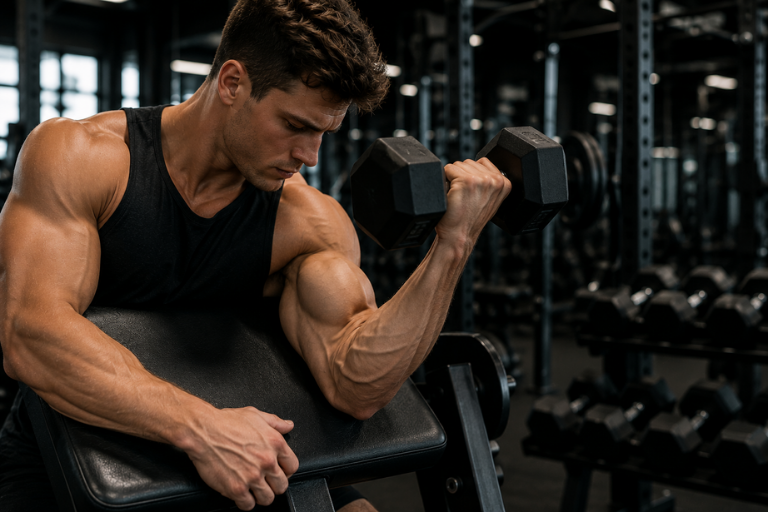
- Lowering a dumbbell during a curl;
- Controlling the descent of a squat;
- Lowering yourself during a calf raise.
Unfamiliar eccentric training is especially well known for producing DOMS.
That does not make eccentric training bad. It is a normal and useful part of resistance training. The important point is that new or unusually demanding eccentric work tends to create more soreness than training your body has already adapted to.
DOMS Is Not Lactic Acid “Stuck” in the Muscle
The common explanation that soreness comes from lactic acid remaining in the muscle for days is incorrect.
Lactate levels return toward normal relatively quickly after exercise, while DOMS develops much later.
Research has failed to support lactate accumulation as the cause of delayed soreness.
So while the exact physiology of DOMS remains complex, “lactic acid trapped in the muscle” is not a good explanation.
Are Muscle Soreness and Muscle Damage the Same Thing?
Not exactly.
Exercise-induced muscle damage can be accompanied by:
- Temporary strength loss;
- Structural changes;
- Reduced range of motion;
- Swelling;
- Changes in certain blood markers;
- Soreness.
But those markers do not all rise and fall together.
In a study involving 110 participants who performed different amounts of maximal eccentric exercise, researchers found that soreness had weak or nonexistent relationships with several other indicators of muscle damage.
The conclusion was clear:
DOMS is a poor indicator of how much muscle damage actually occurred.
So:
More soreness does not necessarily mean more damage.
And even more importantly:
More muscle damage does not necessarily mean more muscle growth.
Does Muscle Soreness Mean Muscle Growth?
No.
A productive workout can cause soreness and contribute to hypertrophy at the same time. The mistake is assuming that soreness proves growth is happening.
Research helps explain why.
When someone starts a new resistance-training program, the first sessions can produce significant muscle damage and a large increase in muscle protein synthesis.
However, part of that early protein synthesis appears to support repair and remodeling rather than directly building new muscle tissue.
As the body adapts and muscle damage decreases, post-training protein synthesis becomes more closely associated with actual hypertrophy.
Reviews examining muscle damage and resistance training have concluded that damage does not appear to be a necessary process that drives or enhances muscle growth.
That means you can:
- Have a productive workout with little soreness;
- Have a productive workout with moderate soreness;
- Become extremely sore from a new stimulus without exceptional hypertrophy;
- Continue building muscle even when your normal training rarely makes you sore.
Can a Workout Still Work If You Are Not Sore?
Absolutely.
As you repeat the same program, it is normal for it to produce less soreness.
That does not mean the workout stopped working.
One of the main reasons is the repeated-bout effect.
Why Do New Exercises Make You So Sore?
You may train legs consistently and barely feel sore anymore.
Then you change exercises, increase range of motion, or bring back a movement you have not performed in months.
A day or two later, your legs feel dramatically different.
The most obvious explanation is novelty.
A new exercise can load a muscle in a way it is not fully adapted to. That unfamiliar stress is strongly associated with DOMS and exercise-induced muscle damage.
This is also why constantly changing exercises just to “feel sore again” is a poor training strategy.
You can increase soreness simply by increasing novelty.
Novelty and muscle growth are not the same thing.
The Repeated-Bout Effect: Why the Same Workout Stops Hurting
After an initial exposure to a certain type of exercise, a later similar session usually produces less soreness and less muscle damage.
This is known as the repeated-bout effect.
Repeated exposure can lead to:
- Less soreness;
- Smaller losses in strength;
- Lower changes in some damage markers;
- Faster recovery.
The exact mechanisms likely involve a combination of neural, structural, cellular, and connective-tissue adaptations.
The practical lesson is simple:
You can become less sore while becoming better adapted to your training.
If your loads, repetitions, technique, and work capacity are still improving, less DOMS is not a reason to abandon a program that is working.
Does More Soreness Mean a Better Workout?
No.
Chasing soreness creates poor incentives.
If your only goal is to wake up as sore as possible, you could:
- Perform unfamiliar exercises;
- Suddenly increase training volume;
- Add far more sets than usual;
- Use a lot of unfamiliar eccentric work;
- Train a muscle hard after several weeks away.
None of those strategies automatically creates a better hypertrophy program.
Excessive soreness can also temporarily reduce strength and range of motion.
At that point, chasing soreness can interfere with the things that matter more:
training consistently, maintaining performance, and progressing over time.
What Does Muscle Soreness Actually Tell You?
DOMS can provide useful context, but it should not be treated as a grade for your workout.
If you completely change an exercise and become unusually sore, that tells you the stimulus was unfamiliar.
If you return after a month away and feel sore, that is expected.
If you sharply increase training volume and your performance drops for several days, that tells you something about your current recovery capacity.
The mistake is turning a subjective sensation into a direct measurement of hypertrophy.
Instead of asking:
“Am I sore?”
ask:
“Am I progressing?”
Better Indicators Than Muscle Soreness
No everyday metric measures hypertrophy perfectly.
But several things are more useful than how much your muscles hurt.
Performance Progression
Over time, look for whether you can:
- Perform more repetitions with the same weight;
- Lift more weight for similar repetitions;
- Use better technique;
- Train through a greater range of motion;
- Perform the same work with lower perceived effort.
Strength and hypertrophy are not identical, but exercise performance gives you much better information than soreness alone.
Consistency
One brutal workout does not compensate for weeks of poorly organized training.
Muscle growth is built through repeated training over months and years.
A program that lets you train consistently is more valuable than one that leaves you barely able to move for several days.
Body Measurements and Photos
Circumference measurements and progress photos taken under similar conditions can help reveal long-term trends.
They are not perfect.
Hydration, body fat, lighting, glycogen, and measurement technique can all influence results.
The goal is to evaluate trends rather than obsess over one measurement.
Training History
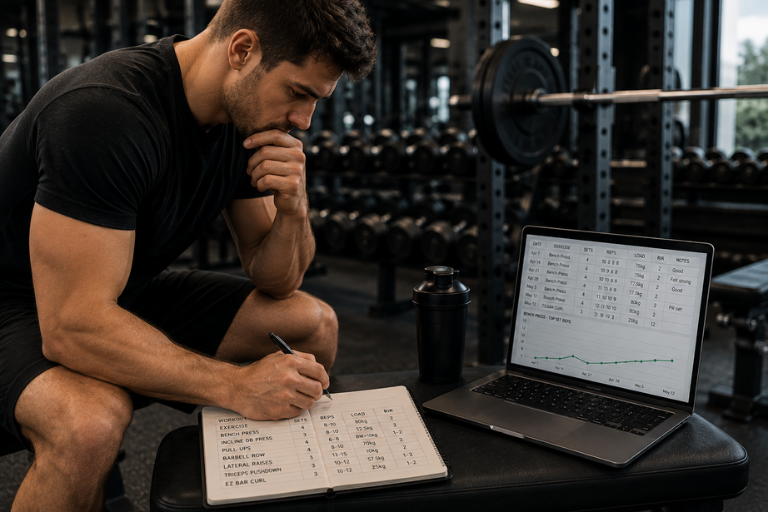
Tracking exercises, sets, loads, and performance gives you real information to compare.
If you can perform more repetitions with the same technique and similar effort than you could six weeks ago, that matters.
BestialFit Ascend can help you organize workouts, record loads, and review your training history.
The goal is not to replace soreness with another arbitrary score. It is to compare what you can actually do over time.
Can You Train While You Are Still Sore?
It depends on how severe the soreness is and how much it affects your function.
Mild Soreness
If you only have mild tenderness, normal range of motion, and no meaningful drop in performance, DOMS alone does not necessarily mean you need to skip your workout.
A gradual warm-up can help you judge how the muscle feels that day.
Moderate or Severe Soreness
If soreness comes with:
- A clear loss of strength;
- Significant stiffness;
- Restricted range of motion;
- Major changes in technique;
- Difficulty with normally easy movements;
then forcing another heavy session for the same muscle may not be the best choice.
You may need to:
- Use less weight;
- Reduce volume;
- Train another muscle group;
- Allow more recovery.
There is no universal rule saying every muscle needs exactly 48 hours of rest.
Your actual function and performance matter more.
Normal Muscle Soreness or a Possible Injury?
DOMS usually follows a different pattern from an acute injury.
Typical DOMS tends to:
- Develop after training rather than as sudden sharp pain during a repetition;
- Affect the trained muscle;
- Cause tenderness and stiffness;
- Improve gradually;
- Sometimes reduce strength and range of motion temporarily.
An acute injury may involve:
- Sudden pain during movement;
- A tearing sensation;
- Significant swelling;
- Bruising;
- Difficulty using the area normally.
These signs cannot diagnose an injury by themselves.
If your symptoms do not resemble your usual post-workout soreness, professional evaluation may be appropriate.
Joint Pain Is Not Normal DOMS
DOMS is primarily muscular.
Pain inside or around a joint—especially when sharp, recurring, unstable, or limiting normal movement—should not be treated as proof that you trained effectively.
If an exercise repeatedly causes joint pain, simply tolerating it better is not the solution.
Warning Signs: When Post-Workout Pain Needs Medical Attention
There is a big difference between sore quads after squats and symptoms that may indicate something more serious.
Seek medical attention if you develop warning signs such as:
- Extremely severe muscle pain;
- Significant swelling;
- Marked weakness;
- Difficulty performing normal daily activities;
- Dark urine that looks like tea or cola.
These symptoms can occur in serious conditions such as rhabdomyolysis.
Do not try to diagnose rhabdomyolysis based on internet information or urine color alone. Proper diagnosis requires medical evaluation and testing.
Do You Need to Do Anything to Get Rid of DOMS?
In most normal cases, time and basic recovery are enough.
That does not mean nothing can change how sore you feel.
A 2025 umbrella review analyzed 29 systematic reviews covering 863 unique randomized trials and several physical-therapy approaches for DOMS.
Some interventions, including massage, compression, cold, and heat, appeared to reduce soreness under certain conditions.
However, the quality of the evidence varied substantially.
Seventeen of the reviews were rated as critically low quality, while only two were considered high quality.
So even if a strategy reduces soreness, that does not automatically mean it fully restores muscle function or improves hypertrophy.
Normal DOMS also does not require an entire collection of recovery products.
The Mistake of Trying to Get Sore After Every Workout
Imagine two lifters.
The first keeps a relatively stable exercise selection, controls volume, progresses loads and repetitions, and feels little soreness most weeks.
The second constantly changes exercises, adds new techniques, increases volume to “destroy” the muscle, and spends several days sore after every session.
If soreness were the best indicator of growth, the second approach would seem superior.
But that is not what the evidence suggests.
The first lifter may simply be well adapted to the program while continuing to accumulate productive training over time.
That is exactly what the repeated-bout effect helps explain.
Your goal should not be to figure out how to make every workout hurt again.
Your goal should be to keep giving your body a reason to adapt.
Quick Takeaways
- Muscle soreness is not required for muscle growth;
- More soreness does not automatically mean more hypertrophy;
- DOMS is common after intense or unfamiliar exercise;
- Unfamiliar eccentric training often causes greater soreness;
- Soreness does not accurately measure muscle damage;
- Muscle damage does not appear to be necessary for hypertrophy;
- Repeated exposure to the same training usually reduces soreness;
- A workout can continue working even when it stops causing DOMS;
- Loads, repetitions, technique, consistency, and long-term performance are better indicators of progress;
- Mild soreness does not always require skipping a workout;
- Severe soreness with reduced function may justify lowering training stress;
- Joint pain, sudden pain, major swelling, or unusual symptoms should not be treated as “good soreness”;
- Severe muscle pain with weakness and dark urine requires medical attention.
Frequently Asked Questions
If I’m Not Sore the Next Day, Did I Train Poorly?
No.
The absence of soreness does not mean the muscle was not stimulated.
As you become adapted to an exercise, it often produces less DOMS.
Judge your training by performance, execution, effort, volume, and long-term progress.
How Long Does DOMS Usually Last?
It varies, but soreness is often most noticeable within roughly 24 to 72 hours after unfamiliar training and then gradually improves.
Very aggressive or novel workouts may cause symptoms for longer.
Do I Need at Least Some Soreness to Build Muscle?
No.
There is no minimum amount of DOMS required for hypertrophy.
Does Extreme Soreness Mean More Muscle Damage?
Not reliably.
DOMS has a weak relationship with several other markers of exercise-induced muscle damage.
Can I Train Legs Again If They Are Still Sore?
Mild soreness without meaningful loss of function does not automatically prevent training.
If you have a clear drop in strength, severe stiffness, restricted movement, or substantial pain, reducing or postponing heavy work may be more appropriate.
Does Stretching Eliminate DOMS?
Stretching should not be treated as a reliable way to eliminate soreness.
Research on DOMS interventions is mixed, and evidence quality varies.
Can Massage Help?
Some research suggests massage can reduce perceived soreness at certain points during recovery.
Feeling less sore, however, does not automatically mean the muscle is fully recovered or that massage improves muscle growth.
Why Was I More Sore When I First Started Training?
Because almost everything was new.
Repeated exposure creates adaptations that reduce the response to similar training. That is the repeated-bout effect.
Should I Change My Workout Once It Stops Making Me Sore?
No.
Change exercises when there is a programming reason to do so—not simply because you want soreness back.
Conclusion
Muscle soreness does not mean muscle growth.
DOMS can happen alongside a productive workout, but it is not a reliable measure of hypertrophy, workout quality, or muscle damage.
In fact, becoming less sore as you repeat an exercise is a normal adaptation.
That is why “no pain, no gain” is a poor way to program your training.
A workout does not need to destroy you to work.
The more useful question is not:
“How much did this hurt afterward?”
It is:
“Am I doing more, doing it better, or performing it with greater control over time?”
Track your exercises, sets, loads, and performance across several weeks.
BestialFit Ascend can help you organize your workouts, record your loads, and review your training history over time.
Use soreness as secondary information about recovery and how unfamiliar a stimulus was.
Do not use it as your main measure of a successful workout.
Disclaimer: This article is for educational purposes only and does not replace medical evaluation or individualized guidance from qualified professionals. Severe or persistent pain, joint pain, pain associated with trauma, major loss of function, significant swelling, unusual weakness, or dark urine should be properly evaluated.
References
- Wiecha S, Cieśliński I, Wiśniowski P, et al. Physical Therapies for Delayed-Onset Muscle Soreness: An Umbrella and Mapping Systematic Review with Meta-meta-analysis. Sports Medicine. 2025;55(5):1183–1212. DOI: 10.1007/s40279-025-02187-5. PMID: 40120073.
- Paschalis V, Margaritelis NV, Chatzinikolaou PN, Theodorou AA, Nikolaidis MG. Eccentric Exercise and Muscle Damage: An Introductory Guide. Journal of Functional Morphology and Kinesiology. 2026;11(2):139. DOI: 10.3390/jfmk11020139. PMID: 42029507.
- Damas F, Libardi CA, Ugrinowitsch C. The development of skeletal muscle hypertrophy through resistance training: the role of muscle damage and muscle protein synthesis. European Journal of Applied Physiology. 2018;118(3):485–500. DOI: 10.1007/s00421-017-3792-9. PMID: 29282529.
- Damas F, Phillips SM, Libardi CA, et al. Resistance training-induced changes in integrated myofibrillar protein synthesis are related to hypertrophy only after attenuation of muscle damage. The Journal of Physiology. 2016;594(18):5209–5222. DOI: 10.1113/JP272472. PMID: 27219125.
- Hotfiel T, Freiwald J, Hoppe MW, et al. Advances in Delayed-Onset Muscle Soreness (DOMS): Part I: Pathogenesis and Diagnostics. Sportverletzung Sportschaden. 2018;32(4):243–250. DOI: 10.1055/a-0753-1884. PMID: 30537791.
- Nosaka K, Newton M, Sacco P. Delayed-onset muscle soreness does not reflect the magnitude of eccentric exercise-induced muscle damage. Scandinavian Journal of Medicine & Science in Sports. 2002;12(6):337–346. DOI: 10.1034/j.1600-0838.2002.10178.x. PMID: 12453160.
- McHugh MP, Connolly DAJ, Eston RG, Gleim GW. Exercise-induced muscle damage and potential mechanisms for the repeated bout effect. Sports Medicine. 1999;27(3):157–170. DOI: 10.2165/00007256-199927030-00002. PMID: 10222539.
- Schwane JA, Watrous BG, Johnson SR, Armstrong RB. Is Lactic Acid Related to Delayed-Onset Muscle Soreness? The Physician and Sportsmedicine. 1983;11(3):124–131. DOI: 10.1080/00913847.1983.11708485. PMID: 27409551.