How Many Sets per Muscle per Week for Muscle Growth?

How many sets per muscle per week do you actually need to build muscle?
You’ll often see numbers like 10, 15, or 20 sets presented as if there were one perfect target. There isn’t.
For many beginners and intermediate lifters, roughly 8 to 15 fractional sets per muscle per week is a reasonable starting zone. But that number only becomes useful once you understand what actually counts as a set.
A muscle that already gets plenty of indirect work from compound lifts may need little isolation work. A lagging muscle that receives less meaningful stimulation elsewhere may benefit from more direct volume.
- Not every set contributes equally to every muscle involved;
- More volume can produce more growth, but with diminishing returns;
- Training frequency is mostly a way to distribute volume efficiently;
- The best volume is the amount you can recover from while continuing to progress.
What Actually Counts as a Set for Muscle Growth?
A light warm-up set is not equivalent to a hard working set.
A useful definition of a working set is a set performed with appropriate resistance, controlled technique, sufficient range of motion, and enough proximity to failure to meaningfully challenge the target muscle.
Warm-up sets usually should not count toward weekly hypertrophy volume. If a set is light and ends with many repetitions in reserve, its main purpose is preparation. But if a “warm-up” becomes hard enough to finish close to failure, it is no longer purely a warm-up.
For many traditional working sets, finishing around 0 to 4 repetitions in reserve, or RIR, is a practical range. An RIR of 2 means you believe you could have completed roughly two more good repetitions before failure.
Training closer to failure can increase the stimulus of a set, but reaching failure every time is not required for muscle growth and can create more fatigue. Technique matters too: if range of motion collapses, other muscles take over, or the movement becomes impossible to reproduce between workouts, that set becomes less useful for tracking.
Direct, Indirect, and Fractional Sets
A direct set is one where the muscle you are tracking is one of the main targets of the exercise. Examples include curls for the biceps, pressdowns for the triceps, lateral raises for the lateral delts, leg extensions for the quadriceps, and flyes for the chest.
A practical convention is to count each direct set as 1.
An indirect set is one where the muscle contributes meaningfully but is not the primary target. Examples include the biceps during rows and pulldowns, the triceps during bench presses, and the front delts during pressing movements.
Ignoring this work can underestimate volume. Counting every indirect set as a full set can overestimate it.
A practical compromise is:
- Direct set: 1;
- Meaningful indirect set: about 0.5;
- Minor contribution or mostly stabilization: 0.
A recent meta-regression found that fractional counting provided the strongest relative fit for predicting hypertrophy compared with treating indirect sets as full sets or ignoring them entirely.
That does not mean every compound lift gives each synergist exactly half a set of growth stimulus. The 0.5 value is an accounting tool, not a biological constant.
For example, one bench press set may count as one direct chest set and roughly half a set for the triceps. A pulldown may count as one direct lat set and roughly half a set for the biceps.
Does More Volume Always Build More Muscle?
In general, doing more hard sets tends to produce more hypertrophy than doing very little.
A 2017 meta-analysis found a positive relationship between weekly resistance-training volume and increases in muscle size. In 2026, the American College of Sports Medicine published an updated position stand synthesizing 137 systematic reviews involving more than 30,000 participants. For hypertrophy, higher weekly volumes were generally associated with better outcomes.
But this does not mean there is a magic threshold.
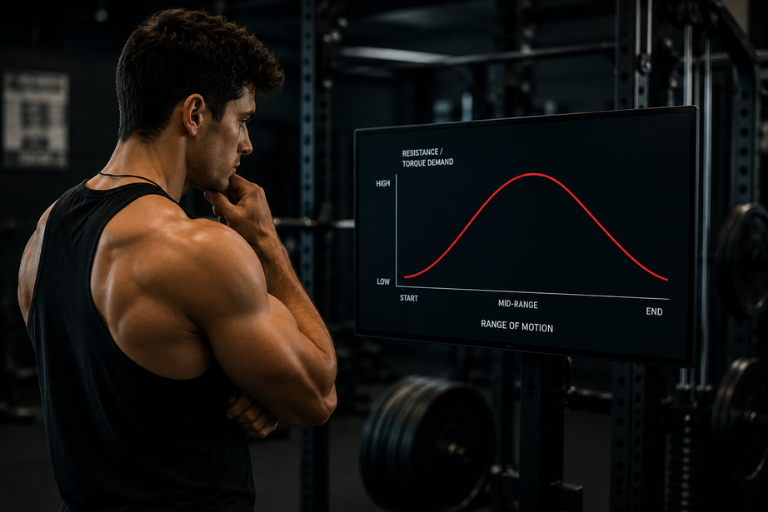
The most recent meta-regression suggests that the relationship between volume and hypertrophy is curved rather than linear. Each extra set tends to provide a smaller additional benefit than the one before it.
Going from two sets to six may make a substantial difference. Going from six to ten may still help. Going from ten to fourteen may add some benefit, but usually less. Going from twenty to twenty-four may add relatively little while increasing fatigue and training time.
That is the practical meaning of diminishing returns.
Higher volume can still work. It simply becomes less efficient.
Weekly Volume vs. Volume per Workout
Weekly volume tells you how much work you perform across the week. Per-session volume tells you how much of that work is concentrated into one workout.
Imagine two lifters both performing 16 weekly chest sets. One does all 16 in one session. The other performs eight sets twice per week.
Their weekly totals are identical, but the quality of the later sets may not be.
As fatigue builds, load, repetitions, stability, range of motion, and execution can decline.
A recent meta-regression available as a preprint found a positive relationship between per-session volume and hypertrophy, again with diminishing returns. The authors estimated that beyond roughly 11 fractional sets for the same muscle in one session, additional work had a low probability of producing more than a very small extra benefit. Data at very high per-session volumes are still limited, so this should not be treated as a hard cap.
As a practical rule, if you routinely perform more than about 8 to 10 fractional sets for one muscle in one session, it may be worth moving some of that work to another day.
How Often Should You Train Each Muscle?
When weekly volume is matched, higher training frequency does not appear to produce a large, consistent hypertrophy advantage by itself.
Frequency is mainly a programming tool. Training a muscle more often can help distribute weekly sets, preserve set quality, shorten workouts, and avoid cramming too much work into one session.
For many lifters, training each muscle around twice per week is a convenient balance. Once per week can still work when volume is appropriate. Three or more exposures can be useful when weekly volume is high or shorter sessions fit your schedule better.
How Many Sets per Muscle per Week Should You Start With?
These are starting zones, not fixed prescriptions.
For beginners or lifters returning after a break, around 6 to 10 fractional sets per muscle per week is often enough.
For intermediate lifters, around 8 to 15 fractional sets per muscle per week is a broad and practical range.
If a specific muscle is a priority, roughly 12 to 18 fractional weekly sets may be worth testing, provided recovery and performance remain good.
Advanced lifters may use around 10 to 20 sets or more, depending on training history. Previous response matters more than the label “advanced.”
For maintenance, roughly 4 to 8 hard sets per week may be enough for some lifters during certain phases.
During a cut, you do not automatically need more volume. If recovery worsens, maintaining or slightly reducing volume may be more productive.
The goal is not to start with the highest number you can survive. Start with the lowest amount that appears sufficient to produce measurable progress.
Practical Example
Imagine your weekly chest and triceps training includes three sets of bench press, three sets of incline press, two sets of flyes, three sets of cable pressdowns, and two sets of overhead triceps extensions.
For the chest, that gives you 8 direct sets.
For the triceps, the six pressing sets may contribute about three fractional sets, while the isolation exercises add five direct sets. That gives you roughly 8 fractional triceps sets.
The same logic applies to back and biceps. If you perform eight total sets of rows and pulldowns plus four sets of curls, the biceps may receive roughly four fractional sets from pulling plus four direct sets from curls.
This is why counting only isolation work can be misleading.
Shoulders and back also need more careful tracking. Front delts already receive substantial work from pressing, while lateral delts usually rely more on direct lateral-raise work. And “back” is not one muscle: pulldowns, rows, and trunk-extension movements do not train the lats, upper back, rear delts, and spinal erectors equally.
Signs Your Volume May Be Too Low
No single sign proves that you need more volume. The case becomes stronger when several of these happen together:
- You are fully recovered before each session;
- Technique and effort are consistent;
- You have used the same volume for several weeks;
- Load and repetitions have stalled across multiple workouts;
- Sleep, nutrition, and routine are reasonably controlled.
A lack of soreness or pump does not mean the workout failed.
Signs Your Volume May Be Too High
Your current volume may exceed your recovery capacity when several of the following appear together:
- Loads or repetitions decline across multiple workouts;
- Technique breaks down earlier than usual;
- Muscle soreness lasts until the next session;
- Joint discomfort gradually increases;
- Later sets require large reductions in load;
- Workouts become so long that consistency suffers;
- Reducing volume temporarily causes performance to rebound.
Poor sleep, stress, illness, and calorie deficits can create similar symptoms, so volume should never be judged in isolation.
Persistent pain, sudden loss of strength, or restricted movement should be evaluated by an appropriate healthcare professional.
A Simple System for Adjusting Volume
Track your training for at least four weeks.
Record working sets, repetitions, load, estimated RIR, and relevant notes about technique or recovery. Keep the main variables reasonably stable so you can actually identify what is changing.
Then use this rule:
If you are progressing, keep your current volume.
If you are no longer progressing but recovery is good, add one or two weekly sets for that muscle.
If performance is dropping and recovery is poor, remove roughly two to four weekly sets and reassess.
Change one major variable at a time whenever possible.
To make these decisions from real training data rather than memory, BestialFit Ascend can help you organize workouts, record sets and loads, and review your training history. Fractional volume still needs to be interpreted using the method explained in this guide.
BestialFit Ascend is a BestialFit product.
Common Mistakes When Counting Weekly Sets
Common errors include counting only isolation work for the arms, counting warm-ups as hard sets, treating every muscle involved in a compound lift as receiving a full set, and treating the entire back or shoulder complex as one muscle.
Do not add volume every time a workout feels easy. First check load, proximity to failure, technique, rest periods, and exercise selection.
And do not copy someone else’s set count without context. Two lifters can both perform 12 sets while experiencing completely different effort, loading, recovery, and exercise selection.
Limitations of the Evidence
Training-volume research is useful, but it has important limitations.
Many studies last only six to twelve weeks. Study populations are also not perfectly representative of everyone; recent volume research has included mostly young men, so findings should be applied more cautiously to women, older adults, adolescents, and clinical populations.
Hypertrophy is measured in different ways, including ultrasound, MRI, muscle biopsies, fat-free mass, and circumference measurements. Studies also vary in load, repetitions, rest periods, proximity to failure, exercise selection, and participant experience.
A meta-analysis can describe population-level trends. It cannot calculate your personal perfect number of sets.
That is why the best approach combines a reasonable starting range with consistent tracking, recovery, and gradual adjustments.
Disclaimer: This article is for educational purposes only and is not a substitute for individualized guidance from a qualified exercise professional or healthcare provider. Anyone dealing with injury, persistent pain, medical conditions, or relevant physical limitations should seek appropriate professional advice.
Quick Takeaways
- Around 8 to 15 fractional sets per muscle per week is a useful starting zone for many beginner and intermediate lifters;
- Count direct sets as 1 and meaningful indirect sets as roughly 0.5;
- Do not count easy warm-ups;
- More volume can build more muscle, but with diminishing returns;
- Spread higher volumes across multiple sessions when set quality begins to decline;
- Keep your current volume while you are progressing;
- If you are recovered but stalled, add one or two weekly sets;
- If performance and recovery are deteriorating, consider removing two to four sets;
- Judge trends across several weeks, not one workout.
Conclusion
There is no universal number of sets per muscle per week.
Research suggests that more training volume generally produces more hypertrophy, but the benefits show diminishing returns. The difference between doing very little and doing a moderate amount of work is likely much more important than endlessly adding sets.
For many beginners and intermediate lifters, roughly 8 to 15 fractional sets per muscle per week is a useful starting zone.
But that total should include indirect work from compound movements such as presses, rows, and pulldowns.
The best training volume is not the largest amount of work you can survive. It is the lowest amount that keeps producing progress—and that you can gradually increase when it is no longer enough.
Track your sets, loads, repetitions, and RIR for several weeks. If you are progressing, keep the volume where it is. If you are recovered but stalled, add a little. If performance is falling while fatigue keeps rising, remove some work before assuming that the answer is always to train more.
References
Currier BS, D’Souza AC, Fiatarone Singh MA, et al. American College of Sports Medicine Position Stand. Resistance Training Prescription for Muscle Function, Hypertrophy, and Physical Performance in Healthy Adults: An Overview of Reviews. Medicine & Science in Sports & Exercise. 2026;58(4):851–872. DOI: 10.1249/MSS.0000000000003897.
Pelland JC, Remmert JF, Robinson ZP, Hinson SR, Zourdos MC. The Resistance Training Dose Response: Meta-Regressions Exploring the Effects of Weekly Volume and Frequency on Muscle Hypertrophy and Strength Gains. Sports Medicine. 2026;56(2):481–505. DOI: 10.1007/s40279-025-02344-w.
Schoenfeld BJ, Ogborn D, Krieger JW. Dose-response relationship between weekly resistance training volume and increases in muscle mass: a systematic review and meta-analysis. Journal of Sports Sciences. 2017;35(11):1073–1082.
Schoenfeld BJ, Grgic J, Krieger JW. How many times per week should a muscle be trained to maximize muscle hypertrophy? Journal of Sports Sciences. 2019;37(11):1286–1295.
Refalo MC, Helms ER, Trexler ET, Hamilton DL, Fyfe JJ. Influence of Resistance Training Proximity-to-Failure on Skeletal Muscle Hypertrophy: A Systematic Review with Meta-analysis. Sports Medicine. 2023;53(3):649–665.
Murphy C, Koehler K. Energy deficiency impairs resistance training gains in lean mass but not strength: A meta-analysis and meta-regression. Scandinavian Journal of Medicine & Science in Sports. 2022;32(1):125–137.
Remmert J, Pelland J, Robinson Z, et al. Is There Too Much of a Good Thing? Meta-Regressions of the Effect of Per-Session Volume on Hypertrophy and Strength. SportRxiv preprint.







Post Comment