How to Do Warm-Up Sets Without Fatiguing Yourself

Warm-up sets should prepare you for your working weight without creating meaningful fatigue before your actual sets begin.
In practice, this usually means starting light, gradually increasing the load, and reducing the number of repetitions as you get closer to your working weight.
For a heavy compound exercise, a simple starting point could be:
- 40–50% of your working weight for 6–8 reps;
- 60–70% for 3–5 reps;
- 80–90% for 1–3 reps;
- Then begin your working sets.
These percentages are not a universal scientific formula. They are simply a practical way to apply the most important principle:
Arrive at your first working set prepared—not tired.
What Should a Warm-Up Actually Do?
Before a heavy set, you need to be ready to produce force, control the movement, and handle the load you are about to use.
A warm-up can help you:
- Gradually increase body and muscle temperature;
- Rehearse your technique;
- Check how your joints and muscles feel that day;
- Expose yourself progressively to heavier loads;
- Improve your sense of readiness.
A 2025 meta-analysis found that increasing muscle temperature appears to benefit faster force-production qualities such as power and rate of force development more consistently than maximal force itself.
For resistance training, that means you do not necessarily need a long warm-up.
You need to be prepared for the specific exercise you are about to perform.
Warm-ups should also not be treated as a guarantee against injury. A 2026 international consensus supports their role in readiness and performance, but does not support claiming that warming up automatically prevents acute injuries.
Is a General Warm-Up Necessary Before Weight Training?
There is no universal rule saying every workout has to begin with ten minutes on a treadmill or bike.
A short general warm-up may be useful if you:
- Arrive feeling cold;
- Have been sitting for several hours;
- Are training in a cold environment;
- Feel unusually stiff;
- Are about to perform explosive movements.
But always consider the goal.
If you are about to bench press, five minutes on a bike may raise your body temperature, but it does not rehearse your bar path or prepare you progressively for your bench press working weight.
A practical sequence is:
- Short general warm-up, if needed;
- Specific mobility, if needed;
- Progressive warm-up sets for the first important exercise.
Mobility: Do Only What You Actually Need
You do not need a long mobility routine before every workout.
If you can already reach the range of motion you want with good control and without meaningful restriction, the lighter warm-up sets themselves may provide enough preparation.
If a certain area feels unusually restricted that day, a few specific dynamic movements may help.
The goal is not to maximize flexibility five minutes before training.
The goal is to comfortably reach the positions required for the exercise you are about to perform.
How to Do Progressive Warm-Up Sets Without Getting Tired
One of the most common mistakes is doing too many repetitions at every warm-up weight.
Imagine your first working set on the bench press is 100 kg.
You perform:
- 20 kg × 20;
- 40 kg × 15;
- 60 kg × 12;
- 80 kg × 10.
Before your first working set, you have already completed 57 repetitions.
At that point, your warm-up is starting to look like a workout.
A much more economical progression could be:
- 20 kg × 8–10;
- 50 kg × 5;
- 70 kg × 3;
- 85 kg × 1–2;
- 100 kg → first working set.
As the weight goes up, the number of repetitions goes down.
This lets you experience progressively heavier loads without accumulating unnecessary fatigue.
Research on bench press and squat warm-ups also suggests that simply performing a few repetitions with very light loads may not prepare performance as well as including brief exposure to heavier loads before the working sets.
How Many Warm-Up Sets Should You Do?
There is no mandatory number.
The main question is how much weight you need to bridge between your starting point and your working load.
For Relatively Light Working Loads
One or two warm-up sets may be enough.
For example:
- 50% of working weight × 6–8;
- 70% × 3–5;
- Working sets.
For Moderate Working Loads
Two or three stages are a good starting point:
- 40–50% × 6–8;
- 60–70% × 3–5;
- 80–85% × 1–3;
- Working sets.
For Heavy Working Loads
The heavier the absolute load becomes, the more useful smaller jumps may be.
You might start with the empty bar and gradually increase the load across four or five warm-up sets while keeping the final sets very low in repetitions.
Someone squatting 60 kg does not necessarily need the same number of warm-up steps as someone whose working sets are performed with 180 kg.
Example: How to Warm Up for Bench Press
Suppose your working weight is:
100 kg for 6–8 repetitions.
A possible sequence would be:
- 20 kg bar × 8–10;
- 50 kg × 5;
- 70 kg × 3;
- 85 kg × 1–2;
- 100 kg → working sets.
You do not need to copy these exact numbers.
If 100 kg is relatively light for you, or if you have already performed another heavy pressing movement, you may need fewer steps.
Example: How to Warm Up for Squats
If your working weight is 140 kg:
- Empty bar × 8;
- 60 kg × 5;
- 90 kg × 3;
- 115 kg × 2;
- 130 kg × 1;
- 140 kg → working sets.
The purpose of the final warm-up sets is not to tire your legs.
It is to make sure 140 kg does not feel like an abrupt jump from a much lighter load.
How to Warm Up on Machines
Machines usually require less technical preparation than a heavy free-weight squat or bench press.
If your first working set on the leg press is 200 kg, for example:
- 80 kg × 8;
- 130 kg × 4;
- 170 kg × 2;
- 200 kg → working sets.
But context matters.
If you just finished heavy squats, you are not starting your leg workout from zero.
In that case, one short preparation set on the leg press may be enough to adjust your position, range of motion, and feel for the machine.
Do Isolation Exercises Need Warm-Up Sets?
It depends on where they appear in your workout.
If a biceps curl is your first exercise of the day, one light set may be useful.
If you have already done several rows and pulldowns, your biceps and elbows have already been exposed to multiple working sets.
Doing three or four preparation sets before curls at that point is probably unnecessary.
The same logic applies to triceps work after pressing movements and many isolation exercises after compound lifts.
Do not restart your entire warm-up process from zero for every exercise.
Do You Need to Warm Up Again When You Change Exercises?
Ask yourself three questions.
Is the New Exercise Similar to the Previous One?
Moving from flat bench press to incline bench press usually requires less additional preparation than moving from bench press to squats.
Will the First Working Set Be Heavy?
The heavier the load, the more useful a short ramp-up may be.
Has That Area Been Inactive for a While?
If a long time has passed or you have spent several exercises training another part of the body, a small re-warm-up may make sense.
A 2025 study found improvements in squat velocity and power when participants performed a re-warm-up after bench pressing. The reverse sequence showed less effect on the bench press.
That is only one study, so it should not be treated as a universal rule. But it illustrates an important point: whether you need to warm up again depends on exercise order and context.
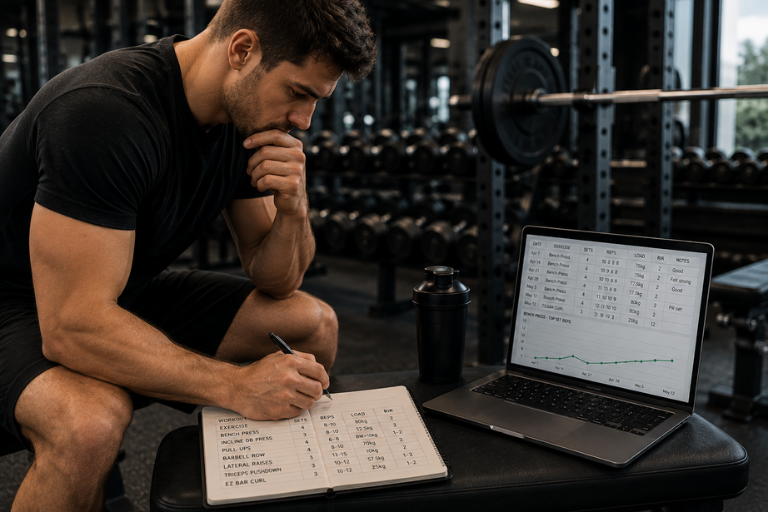
Save a simple warm-up protocol for your main exercises in your phone or training notes. After a few sessions, you will not have to reinvent your warm-up every time you enter the gym.
Do You Need More Warm-Up on Cold Days?
Sometimes.
If you arrive noticeably cold and it takes longer to feel ready, a few minutes of general movement before your specific warm-up sets may be useful.
Research suggests that increasing muscle temperature can improve certain rapid force-production qualities.
That does not mean you need to finish your warm-up exhausted or drenched in sweat.
Use your preparation sets to judge whether you actually feel ready.
What If You Have a History of Discomfort?
Light warm-up sets can help you assess how a movement feels on a particular day.
But recurring pain should not be managed by endlessly adding more warm-up exercises.
If you have persistent pain, progressively worsening symptoms, or meaningful limitations in function, professional evaluation is more appropriate than trying to “warm up until it goes away.”
Should You Avoid Static Stretching Before Lifting?
Static stretching is not automatically bad before resistance training.
The important variables are duration and context.
Reviews have found small acute reductions in strength performance under certain conditions after static stretching, particularly when stretches are held for longer periods. Shorter bouts tend to have smaller effects.
So spending several minutes on intense static stretching immediately before a heavy squat is probably not the best strategy.
If you need a little more range of motion for a specific exercise, use the minimum amount necessary and then transition into dynamic movement and specific warm-up sets.
A Simple Warm-Up Formula to Remember
For your first important compound exercise, think:
Light weight + more reps → moderate weight + fewer reps → heavy weight + very few reps → working sets.
A practical starting point:
- 40–50% × 6–8;
- 60–70% × 3–5;
- 80–90% × 1–3;
- Working weight.
For very heavy exercises, add more steps.
For machines, isolation work, or exercises performed after a similar movement, remove steps.
And remember: a warm-up set should not turn into a difficult set close to failure.
Common Warm-Up Mistakes
Warming Up Close to Failure
If you finish your warm-up breathing heavily and grinding out the final reps, you probably did too much.
Doing Too Many Repetitions
As the load increases, the number of repetitions should usually decrease.
Jumping Straight From the Empty Bar to a Heavy Weight
That removes the gradual load exposure the warm-up is supposed to provide.
Doing Long Cardio Before Every Workout
General warm-up can be useful, but excessive duration or intensity may simply add fatigue.
Repeating the Entire Process for Every Exercise
Consider the work you have already done.
A second exercise with a similar movement pattern usually requires less preparation.
Quick Takeaways
- Your warm-up should prepare you without tiring you out;
- Light cardio can be useful, but it does not need to start every workout;
- Prioritize exercise-specific warm-up sets;
- Start light and gradually increase the load;
- Reduce repetitions as the weight increases;
- Heavy compound lifts usually justify more warm-up steps;
- Machines and isolation exercises generally require fewer;
- A second similar exercise does not need the entire process repeated;
- Avoid prolonged, intense static stretching immediately before heavy lifting;
- Save a simple warm-up protocol for your main exercises.
Frequently Asked Questions
Does a Warm-Up Set Count as a Working Set?
Usually not.
Its purpose is to prepare you for the planned work, not to create the same level of effort or stimulus as a working set.
How Long Should You Rest Between Warm-Up Sets?
Very light loads usually require little rest.
As you approach your working weight, taking slightly longer rests can help prevent the warm-up itself from reducing your performance.
There is no mandatory rest interval that applies to everyone.
Do You Need to Warm Up for Every Exercise?
No.
A new movement pattern, a heavy working load, or a muscle group that has not been trained yet may justify additional preparation.
Similar exercises performed back-to-back usually require less.
Can You Do Just One Warm-Up Set?
Yes.
That may be enough for machines, isolation exercises, moderate loads, or movements performed after similar exercises.
Are More Light Repetitions Better?
Not necessarily.
Too many repetitions can create fatigue before your working sets.
As you increase the load, reduce the number of repetitions.
Conclusion
Warm-up sets do not need to be complicated.
The goal is to reach your first working set prepared to produce force and control the exercise without using up performance before the real work starts.
Increase the load gradually, reduce repetitions as the weight rises, and adjust the number of warm-up steps to the situation.
Heavy compound lifts may require several ramp-up sets.
Machines, isolation exercises, and movements similar to exercises you have already performed usually need fewer.
Save a warm-up protocol for each of your main exercises and refine it with experience. After a few sessions, you will have a consistent preparation routine without having to figure everything out again every time you train.
A good warm-up should make you feel more ready to train—not like you have already started the workout tired.
References
- Boullosa D, Gil-Calvo M, Xenofondos A, et al. International Expert Consensus on Warm-Up Protocols for Athletes: A Delphi Study. International Journal of Sports Physiology and Performance. 2026. DOI: 10.1123/ijspp.2025-0647. PMID: 42476526.
- Kłobuchowski W, Skorulski M, Ornowski K, et al. Exercise-Based Strategies from Warm-Up to Training: A Systematic Review of Performance Enhancement and Injury Prevention. Sports. 2026;14(5):187. DOI: 10.3390/sports14050187. PMID: 42188564.
- Wilson CJ, Nunes JP, Blazevich AJ. The effect of muscle warm-up on voluntary and evoked force-time parameters: A systematic review and meta-analysis with meta-regression. Journal of Sport and Health Science. 2025;14:101024. DOI: 10.1016/j.jshs.2025.101024. PMID: 39864808.
- Ribeiro B, Pereira A, Neves PP, et al. The Role of Specific Warm-up during Bench Press and Squat Exercises: A Novel Approach. International Journal of Environmental Research and Public Health. 2020;17(18):6882. DOI: 10.3390/ijerph17186882. PMID: 32971729.
- Viveiros L, Gioia K, Nasser I, et al. High-load and low-volume warm-up increases performance in a resistance training session. Journal of Bodywork and Movement Therapies. 2024;40:1487–1491. DOI: 10.1016/j.jbmt.2024.08.004. PMID: 39593476.
- Neves PP, Marques DL, Neiva HP, et al. Impact of Re-Warm-Up During Resistance Training: Analysis of Mechanical and Physiological Variables. Sports. 2025;13(5):142. DOI: 10.3390/sports13050142. PMID: 40423278.
- Behm DG, Blazevich AJ, Kay AD, McHugh M. Acute effects of muscle stretching on physical performance, range of motion, and injury incidence in healthy active individuals: a systematic review. Applied Physiology, Nutrition, and Metabolism. 2016;41(1):1–11. DOI: 10.1139/apnm-2015-0235. PMID: 26642915.