Which Exercise Should You Do First in a Workout?
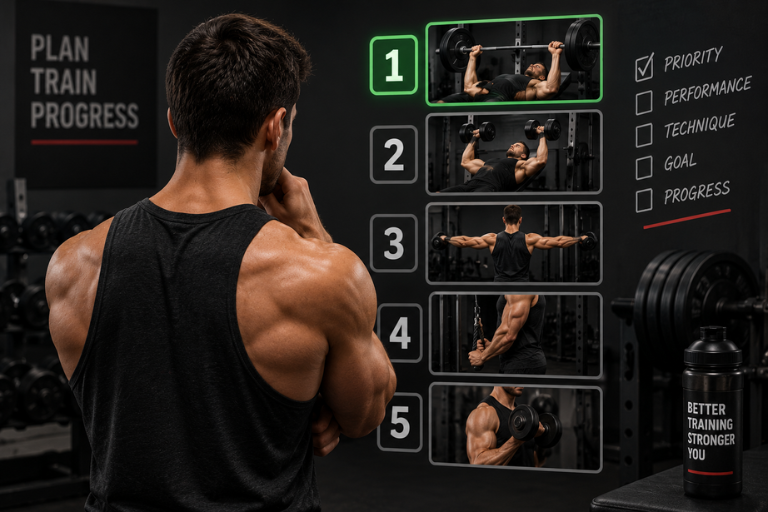
The best exercise order is not simply “big muscles first” or “compound exercises first.” A better approach is to put the movements that matter most to your goal at the point in the workout when you have the most energy and least accumulated fatigue.
If your priority is improving your bench press, for example, the bench press should generally come before exercises that significantly fatigue your chest, triceps, or front delts. If your priority is bringing up a specific muscle, the exercise that trains that muscle most effectively can come first—even if it is an isolation exercise.
The principle is simple: the exercise you perform first is usually the exercise on which you can produce your best performance.
That makes exercise order a tool for managing fatigue, rather than a rigid rule based only on muscle size.
Why Does Exercise Order Matter?
Fatigue accumulates throughout a workout.
After several demanding sets, you may still be able to perform the next exercise, but your ability to produce force, stabilize your body, coordinate the movement, and maintain your usual repetitions may be reduced.
This matters because research indicates that strength gains tend to be greater in exercises performed earlier in a workout. A systematic review and meta-analysis found that, when exercise order was compared, the largest strength improvements generally occurred in exercises performed at the beginning of the session.
For hypertrophy, however, the picture is different.
The same meta-analysis did not find a significant overall difference in muscle growth between starting with multi-joint or single-joint exercises.
In other words, exercise order matters more when you want to prioritize the performance of a particular movement or muscle than when the goal is simply overall muscle growth.
Should Compound Exercises Always Come First?
No.
“Compounds first” is a useful rule of thumb for many workouts, but it is not a law.
Compound, or multi-joint, exercises involve multiple joints and muscle groups. Examples include:
- Squats
- Bench presses
- Rows
- Overhead presses
- Deadlifts
- Leg presses
Isolation, or single-joint, exercises place more emphasis on a particular muscle or movement pattern, such as:
- Biceps curls
- Cable triceps extensions
- Lateral raises
- Leg extensions
- Leg curls
If your goal is to improve your squat, starting with the squat usually makes sense.
But imagine that you are specifically prioritizing your lateral delts. If lateral raises are the most important exercise in that session, there is no scientific rule saying they must come after every compound movement.
The better question is:
Which exercise deserves my best performance today?
Muscle Priority Matters More Than Muscle Size
One of the most useful ways to organize a workout is to establish your priorities before deciding on the order.
Think in three levels:
Priority 1: the muscle or movement that most needs to progress.
Priority 2: exercises that are important for maintaining or developing other areas.
Priority 3: accessory movements where a small reduction in performance has less impact on your overall goal.
Exercises associated with Priority 1 generally belong earlier in the workout.
This becomes particularly important during specialization phases.
If you want to prioritize your chest, you might begin with a pressing movement that effectively trains the pecs.
If triceps are your priority, starting with a triceps exercise can make sense—even if you perform bench pressing afterward.
The research on exercise order supports this general principle: programming should consider the priority of the training goal, rather than simply whether an exercise targets a large or small muscle group.
What If My Main Goal Is Strength?
Exercise order becomes even more important when strength is the main objective.
Strength is highly specific to the movement. If you want to improve your bench press, you need to practice the bench press with high-quality execution and the ability to produce force.
For that reason, the exercise you want to improve should generally be performed before movements that could impair your performance through fatigue.
For example, if your goal is to increase bench press strength:
- Bench press
- Another chest movement
- Triceps
- Delts
- Accessories
If you perform several demanding triceps sets before bench pressing, you will probably reach the bench press with less capacity to produce force.
That does not make the reverse order useless. It simply means you are shifting priority toward the triceps.
Research comparing different exercise sequences has consistently found this pattern: strength improvements tend to favor exercises performed earlier in the session.
What About Hypertrophy?
For hypertrophy, you have more flexibility.
A meta-analysis of 11 studies found similar hypertrophy outcomes when multi-joint exercises were performed before single-joint exercises and when the order was reversed.
A six-week study in young men also found muscle growth with both approaches, although it observed a possible advantage for the multi-joint-to-single-joint order in thigh muscle thickness.
So there is no need to turn “compound exercises first” into an absolute rule.
What matters more is ensuring that your priority muscles receive sufficient stimulus and that you can maintain appropriate effort, execution, and progression throughout the program.
When Should You Put an Isolation Exercise First?
This strategy is often described as pre-exhaustion, although the term can refer to several different methods.
Imagine performing:
Lateral raises → overhead press
or:
Triceps extension → bench press
The isolation exercise increases fatigue in the target muscle before the compound movement.
This can make sense when you deliberately want to prioritize that muscle.
But there is an obvious trade-off: your performance on the following compound exercise will probably be lower.
For example, if you fatigue your triceps before bench pressing, you may perform fewer repetitions or use less weight on the bench press.
Therefore, pre-exhaustion is not automatically a better way to structure a workout.
It is a tool.
Use it when reducing performance on the second exercise is an acceptable trade-off for prioritizing the first.
A Simple Decision Tree for Exercise Order
Before starting your workout, ask yourself:
1. Is there an exercise or muscle that is a priority?
If yes, put it early.
2. Is there a technically demanding movement?
If yes, consider performing it before fatigue interferes with coordination and stability.
3. Is there an exercise where you need to maximize strength?
If yes, place it near the beginning.
4. Does an exercise have a higher technical or safety cost when fatigued?
If yes, avoid placing it after several sets that could significantly compromise your execution.
5. Is there a muscle you deliberately want to pre-fatigue?
If yes, an isolation exercise can come before the compound movement.
6. Do you have limited time?
Put the most important exercises first. If the workout gets cut short, your highest-priority work has already been completed.
This approach is more useful than simply organizing everything as “large muscles → small muscles.”
Technically Demanding Exercises Deserve Special Attention
Not every heavy exercise has to be first, but movements that require substantial coordination can be more sensitive to fatigue.
Imagine starting your workout with several demanding exercises that fatigue the muscles involved in a heavy squat, then attempting the squat afterward.
You may still complete the prescribed sets, but your movement quality may not be the same.
Therefore, when an exercise requires substantial:
- Stability
- Coordination
- Body control
- Technique
- Concentration
it is worth considering an earlier position in the session.
This is particularly relevant for free-weight exercises and movements where a major drop in performance could compromise execution.
What If I Have a Joint Limitation?
This requires an individualized approach.
If an exercise repeatedly causes discomfort or does not suit you well, simply moving it to the beginning of the workout does not solve the underlying problem.
Exercise selection, technique, range of motion, load, and training context should all be considered.
Exercise order can help manage fatigue, but it cannot make an unsuitable exercise appropriate for you.
If you have persistent pain or a health condition, seek guidance from an appropriately qualified professional rather than trying to solve the issue solely by rearranging exercises.
How to Organize a Push Workout
Imagine that chest is the priority.
One possible structure would be:
1. Bench press
Main chest movement and highest priority.
2. Incline press or chest machine
Additional chest work.
3. Lateral raises
Specific work for the lateral delts.
4. Triceps
Accessory work for a muscle already involved in pressing.
5. Another isolation exercise, if needed
Additional work.
Now imagine that triceps have become the priority.
You could begin with the triceps exercise and accept that your bench press performance afterward may be somewhat lower.
The structure changed because the priority changed.
How to Organize a Pull Workout
Suppose your priority is developing your lats and improving a rowing movement.
A possible sequence would be:
1. Priority row or pulldown
2. Another lat-focused movement
3. Upper-back exercise
4. Rear delts
5. Biceps
But if your goal is to specialize in biceps, a curl could be moved much earlier.
Again, there is no universally superior order. There is an order that makes more sense for the goal of the session.
How to Organize a Leg Workout
A leg workout might begin with:
1. Squat or another priority movement
2. Leg press or another compound exercise
3. Hamstring exercise
4. Leg extension
5. Leg curl
6. Calves
But if hamstrings are the priority, a hamstring movement can be moved earlier.
If your goal is specifically to emphasize the quads, exercises that contribute most to that goal can receive earlier positions.
What If You Have a Very Short Workout?
When you have only 30 or 40 minutes, exercise order becomes even more important.
You do not necessarily need to randomly remove exercises.
Instead, perform the work that would be most costly to skip or perform while fatigued.
For example:
If your goal is bench press strength, bench press first.
If your priority is lateral delts, perform lateral raises early.
If you simply want a balanced workout, put the most demanding movements first and accessories afterward.
That way, if time runs out, you have already completed the most important part of the session.
What If Two Muscles Are Equally Important?
You can alternate priorities between sessions.
Imagine that chest and shoulders are equally important.
During one workout, start with chest.
During the next, start with shoulders.
This prevents one muscle from consistently receiving the advantage of being trained while you are fresh while the other always has to work under accumulated fatigue.
The same strategy can be applied to different Push, Pull, or Legs sessions.
Does Exercise Order Change Hypertrophy?
It can affect the performance of individual exercises, but the available evidence does not indicate that simply switching the order of multi-joint and single-joint exercises produces a major difference in overall hypertrophy.
The meta-analysis by Nunes and colleagues found no significant effect of exercise order on overall muscle hypertrophy.
This is important because it prevents an exaggerated conclusion:
You do not need to find a “perfect” exercise order to build muscle.
Your exercise order should primarily help you perform your highest-priority work effectively.
A Common Mistake: Organizing by Muscle Size
“Chest before triceps because chest is bigger.”
“Back before biceps because back is bigger.”
These rules can work in many programs, but they do not explain everything.
If you want to prioritize your biceps, starting with biceps can be completely reasonable.
If you want to improve your bench press, the bench press should receive priority.
If you want to develop your lateral delts, performing lateral raises after several exercises that have already consumed your capacity to train may not be the best choice.
Priority matters more than muscle size.
Another Mistake: Trying to Maximize Every Exercise
You cannot put every exercise at the beginning of the workout.
Some movement will inevitably be performed with accumulated fatigue.
So the question should not be:
“What is the perfect order?”
Instead, ask:
“Where do I want to spend my best available performance?”
Once you answer that, accept that later exercises will be performed with some degree of accumulated fatigue.
How to Apply This to Your Workout
Do not completely rebuild your program after reading this article.
Take your current workout and identify:
Priority: Which muscle or exercise actually needs to progress?
Performance: Which movement requires the highest quality?
Technique: Which exercise is most sensitive to fatigue?
Safety: Which movement deserves the greatest degree of control?
Accessories: Which exercises can be performed later without compromising your main goal?
Then reorganize the session around those answers.
You do not need a particular training split to use this approach. The same logic works with Full Body, Upper/Lower, Push/Pull/Legs, and other structures.
Keep Your Workout Organized Around Your Priorities
Exercise order is one of the variables you can adjust without rebuilding your entire training program.
If you already know which movements are priorities, the next step is making sure they actually occupy the right positions in your session.
BestialFit Ascend can help you organize your exercises and training splits so your workouts remain structured around your priorities.
Sign up for free on BestialFit Ascend and organize your exercises around what actually matters in your training.
Click the link below to access BestialFit Ascend and create your free account:
Quick Takeaways
- The first exercise generally receives your best performance.
- For strength, prioritize the movement you want to improve.
- For hypertrophy, the order of compound and isolation exercises is less important than many people assume.
- “Compounds first” is a useful heuristic, not a mandatory rule.
- An isolation exercise can come first when a specific muscle is the priority.
- Technically demanding exercises may deserve earlier positions.
- Do not organize your workout solely according to muscle size.
- In short workouts, put the work you do not want to skip first.
- If two priorities are equally important, alternate which one comes first between sessions.
- Exercise order should distribute fatigue according to your goal rather than follow a universal formula.
Frequently Asked Questions
Which Exercise Should I Do First in a Workout?
Start with the exercise connected to your highest priority. If your main goal is strength in a particular movement, it should generally be performed early. If a specific muscle is your priority, the exercise that best addresses that goal can also occupy an early position.
Should I Always Do Compound Exercises Before Isolation Exercises?
No. It is a common and useful strategy, but it is not mandatory. Research suggests that different exercise orders can produce similar hypertrophy, while exercises performed earlier tend to experience greater specific strength improvements.
Can I Train Biceps Before Back?
Yes, especially if biceps are your priority. The likely trade-off is reduced performance on back exercises that rely heavily on the biceps. Therefore, the decision depends on what you want to prioritize.
Should the Heaviest Exercise Always Come First?
Often, yes—particularly when it is also your priority and requires substantial technique. But “heaviest” alone does not determine exercise order. A lighter exercise may deserve the first position if it represents the main goal of the session.
Does Exercise Order Affect Muscle Growth?
Available evidence suggests that the order of multi-joint and single-joint exercises does not produce major differences in overall hypertrophy. The greater practical effect is usually on the performance and progression of individual exercises.
Can I Do Triceps Before Bench Press?
Yes, if triceps are the priority. However, pre-fatiguing the triceps may reduce your bench press performance. That trade-off should be intentional.
Conclusion
The best exercise order is not necessarily the one that starts with the largest muscle, the heaviest exercise, or every compound movement.
It is the order that puts your priorities in the best possible conditions.
If strength in a specific exercise matters, perform it early. If a particular muscle is the priority, consider starting with the movement that best develops it. If an exercise requires substantial technique or control, avoid burying it behind unnecessary fatigue.
For general hypertrophy, you do not need to obsess over finding the perfect order. The evidence indicates that different sequences can work.
The goal is simpler: decide what matters most, put it first, and organize the rest of the workout around that priority.
Want to organize your workouts more effectively? Sign up for free on BestialFit Ascend, organize your exercises and training splits, and keep your sessions structured around your actual priorities.
Click the link below to access BestialFit Ascend and create your free account:
References
Nunes JP, Grgic J, Cunha PM, Ribeiro AS, Schoenfeld BJ, de Salles BF, Cyrino ES. What influence does resistance exercise order have on muscular strength gains and muscle hypertrophy? A systematic review and meta-analysis. European Journal of Sport Science. 2021;21(2):149–157. DOI: 10.1080/17461391.2020.1733672. PMID: 32077380.
Avelar A, Ribeiro AS, Nunes JP, Schoenfeld BJ, Papst RR, Trindade MCC, Bottaro M, Cyrino ES. Effects of order of resistance training exercises on muscle hypertrophy in young adult men. Applied Physiology, Nutrition, and Metabolism. 2019;44(4):420–424. DOI: 10.1139/apnm-2018-0478. PMID: 30248269.
Assumpção CO, Tibana RA, Viana LC, Willardson JM, Prestes J. Influence of exercise order on upper body maximum and submaximal strength gains in trained men. Clinical Physiology and Functional Imaging. 2013;33(5):359–363. DOI: 10.1111/cpf.12036. PMID: 23701174.
Schoenfeld BJ et al. The influence of resistance training exercise prescription variables on skeletal muscle mass, strength, and physical function in healthy adults: An umbrella review.
:::