How Long Should You Rest Between Sets?
Your rest time between sets should be long enough to recover the performance you need for the next set—without turning your workout into an endless sequence of breaks.
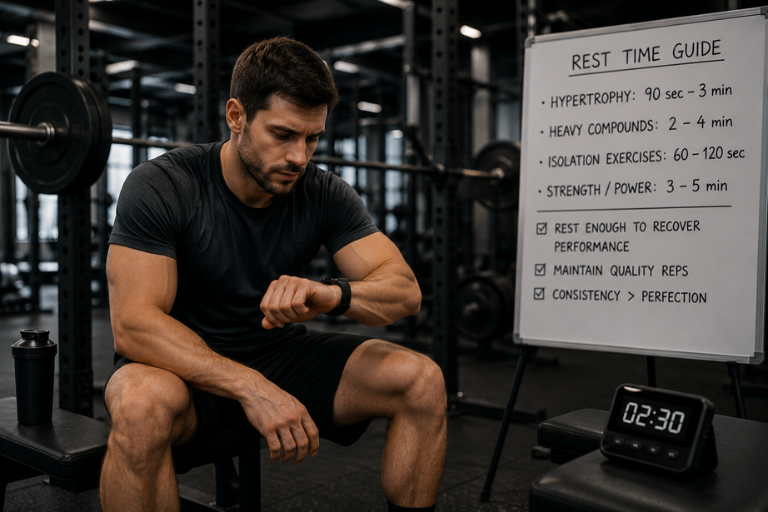
For hypertrophy, roughly 90 seconds to 3 minutes is a practical starting range for many sets. Heavy compound exercises may justify 2–4 minutes, while some isolation exercises may work well with 60–120 seconds.
For maximal strength and power, 3–5 minutes often makes more sense.
But the timer is only a starting point.
The more useful question is:
“After this rest period, can I perform the next set with roughly the repetitions, load, and technique I should be able to maintain?”
If the answer is no, you may be resting too little.
What Actually Needs to Recover Between Sets?
A hard set does not fatigue only the muscle you are trying to train.
During the rest period, several things begin recovering:
- Your ability to produce force;
- Local muscular fatigue;
- Energy availability for intense effort;
- Breathing;
- Cardiovascular demand;
- Coordination and stability;
- Perceived effort.
These do not all recover at exactly the same rate.
That is why your breathing returning to normal does not necessarily mean you are ready to repeat a heavy squat with the same performance.
At the same time, you do not need to feel completely fresh before another set of lateral raises.
Your rest period needs to match the demands of the next set.
What Is the Best Rest Time for Muscle Growth?
Short rest periods have traditionally been associated with hypertrophy training because they increase the feeling of burning, muscle pump, and metabolic stress.
That does not mean resting less automatically builds more muscle.
A 2024 systematic review with Bayesian meta-analysis included nine studies comparing different rest intervals. The results suggested a small hypertrophy advantage for resting longer than 60 seconds, possibly because very short rest periods make it harder to maintain training volume.
However, the analysis did not identify an appreciable hypertrophy advantage from extending rest beyond roughly 90 seconds.
That does not make 90 seconds a magic number.
One study in resistance-trained men, for example, found greater strength gains and some favorable hypertrophy outcomes with three-minute rest periods compared with one minute.
Another experiment added an important nuance: when volume load was controlled, the results suggested that preserving the amount of productive work performed may matter more than the rest interval itself.
So:
Longer rest does not directly cause more muscle growth.
It may help indirectly by allowing you to perform later sets better.
Rest Time for Strength and Power
When maximal strength is the main goal, maintaining performance becomes even more important.
A systematic review of 23 studies found that strength gains can occur with short rest intervals, but trained lifters appear to benefit from resting longer than two minutes when the goal is to maximize strength development.
With heavy loads and low repetitions, losing even one rep represents a large portion of the set.
If you are supposed to perform four heavy reps but only manage two on the next set because you rushed your rest, the quality of the training stimulus has changed substantially.
For heavy squats, bench presses, deadlifts, and similar lifts, 3–5 minutes can be completely reasonable.
Power training also depends on producing force quickly.
If bar speed drops substantially because you are still fatigued, a longer rest period may help preserve the purpose of the set.
How Long Should You Rest Based on the Exercise?
There is no good reason to use the same timer for everything.
Heavy Compound Exercises
Examples include:
- Squats;
- Bench presses;
- Deadlifts;
- Free-weight rows;
- Overhead presses.
For difficult hypertrophy sets, 2–4 minutes is a useful starting range.
For very heavy strength work, 3–5 minutes may be more appropriate.
These exercises involve large amounts of muscle mass, stabilization, and coordination.
Your chest or quads feeling “ready” does not necessarily mean your entire system is ready to reproduce the set.
Compound Machine Exercises
Examples include:
- Leg press;
- Hack squat;
- Chest press;
- Machine row.
A starting point of 90 seconds to 3 minutes is reasonable.
A hard leg press set taken close to failure can still demand substantial recovery even though the movement is performed on a machine.
Isolation Exercises
Examples include:
- Biceps curls;
- Cable triceps extensions;
- Lateral raises;
- Leg extensions;
- Leg curls.
60–120 seconds works well as a practical starting range.
But do not force yourself to rest only one minute just because the exercise is an isolation movement.
If you take a triceps extension very close to failure and your repetitions collapse on the next set, increasing your rest to 90 or 120 seconds may be the better choice.
What Do 60, 90, 120, and 180 Seconds Mean in Practice?
60 Seconds
This can work for:
- Isolation exercises;
- Relatively light sets;
- Sets performed farther from failure;
- Situations where saving time is a priority.
The downside is that fatigue may begin limiting performance.
90 Seconds
This is a useful middle ground for many isolation exercises and machines.
It is also above the main threshold at which the 2024 meta-analysis observed differences between shorter and longer rest periods for hypertrophy.
But that does not mean everyone is fully recovered after 90 seconds.
120 Seconds
Two minutes is an excellent reference point for many hypertrophy sets.
In a study comparing 60, 90, and 120 seconds, the 120-second condition allowed participants to better maintain repetitions across a sequence of upper-body exercises.
180 Seconds
Three minutes makes sense when preserving performance becomes a higher priority:
- Compound lifts;
- Heavier loads;
- Sets close to failure;
- Exercises that generate substantial fatigue;
- Strength-focused training.
Performance studies frequently show that three minutes can allow more repetitions to be maintained than just one minute.
How Do You Know When You Have Rested Enough?
This is the most useful practical rule:
Compare the next set with the previous one.
Imagine:
First set: 10 reps at 1 RIR.
After 60 seconds:
Second set: 6 reps with the same load and a similar level of effort.
Losing four repetitions suggests that your rest interval may be limiting performance significantly.
Now imagine:
First set: 10 reps.
Second set after two minutes: 9 reps.
Third set: 8 reps.
That gradual drop may be far more acceptable.
There is no universal percentage of repetition loss that automatically means you need more rest.
The point is to identify patterns.
If your repetitions collapse too quickly, consider:
- Resting longer;
- Reducing the effort of the first set;
- Reconsidering the amount of volume you are performing.
A 2026 study tested a method that adjusted rest periods based on repetition performance in the previous set. The adjustable protocol preserved more total repetitions than a fixed three-minute rest interval, although it was slightly less time-efficient.
In practice, this becomes much easier when you know exactly how much time has passed since your previous set.
With BestialFit Ascend, you can use the workout timer to track how long you have been resting and combine that information with your exercises, loads, and repetitions.
Sign up for free and use the timer to test which rest intervals help you maintain your performance best between sets.
Click the link below to access BestialFit Ascend and create your free account:
Heart Rate Is Not the Only Sign of Recovery
Waiting for your heart rate to come down can help after very demanding exercises, but it should not be your only criterion.
You can be breathing normally and still not be ready to reproduce your previous force output.
You can also still have an elevated heart rate after a hard leg exercise while being recovered enough to perform a light isolation exercise for another muscle group.
A 2026 meta-analysis comparing self-selected and fixed rest intervals found generally similar heart-rate responses, despite possible small differences in performance maintenance under certain conditions.
Use several signs together:
- Controlled breathing;
- The target muscle feels sufficiently recovered;
- Stable technique;
- Readiness to produce effort;
- Your repetition history from previous sets.
Does Training Close to Failure Require More Rest?
Usually, yes.
A set stopped with several repetitions in reserve generally produces less fatigue than a set taken all the way to the limit.
That means two people can perform the same exercise for the same number of repetitions but still need different rest periods if one person is training much closer to failure.
This is one reason copying someone else’s rest intervals without considering effort can fail.
The harder the previous set was, the more attention you should pay to recovery before the next one.
Does More Rest Mean More Muscle Growth?
No.
The available evidence does not show a relationship where simply resting longer and longer continues to produce more hypertrophy.
The 2024 meta-analysis did not detect an appreciable benefit from extending rest beyond approximately 90 seconds in the available hypertrophy studies.
But that needs to be interpreted correctly.
If three minutes allows you to maintain your repetitions much better on a heavy exercise, then those three minutes may still be useful—even if the third minute itself has no special “anabolic” effect.
The benefit comes from the quality of work the extra recovery allows you to perform.
On the other hand, resting six minutes after every set of lateral raises when you were ready after 90 seconds will probably just make your workout longer.
Do Supersets Hurt Performance?
Supersets combine two exercises with little or no rest between them.
They can be an excellent strategy when time is limited—as long as they are organized intelligently.
A 2025 meta-analysis including 19 studies found that supersets can reduce workout duration while maintaining, on average, similar repetition counts and volume load compared with traditional resistance training.
The longer-term studies also showed similar outcomes for muscle growth and strength, although supersets increased perceived effort and metabolic demand.
Exercise selection matters.
Alternating antagonistic muscles or different body regions generally has a better chance of preserving performance than combining two very similar exercises for the same muscle.
For example:
Bench press → Row → Rest
may preserve performance better than:
Bench press → Chest press → Rest
when your goal is to maintain high-quality work.
How to Save Time Without Ruining Your Sets
If your workouts are taking too long, do not immediately cut every rest period in half.
First look for wasted time from:
- Checking your phone;
- Long conversations;
- Slow equipment changes;
- Unnecessary warm-up sets;
- Redundant exercises.
Then consider intelligently programmed supersets.
Reducing a three-minute rest period to 60 seconds saves time, but it is not a good trade if your next set falls from ten repetitions to five.
The goal is not to finish your workout as quickly as possible. The goal is to get as much productive training as possible within the time you have available.
Common Rest-Time Mistakes
Using 60 Seconds for Everything
One minute can work for some exercises, but it can seriously limit performance on heavy compound movements.
Waiting Until You Feel Completely Fresh
Hypertrophy training does not require you to feel completely recovered before every set.
You just need enough recovery to perform the next set effectively.
Starting Only Because the Timer Beeped
If two minutes have passed but you know your next squat set is going to be dramatically worse, taking another 30–60 seconds can be reasonable.
Resting Indefinitely
Autoregulation does not mean forgetting that you are training.
Once you have recovered enough to perform the next set properly, continuing to wait only makes the workout longer.
Using the Same Rest Period for Every Exercise
A cable triceps extension and a heavy squat do not create the same recovery demands.
Quick Takeaways
- For hypertrophy, start around 90 seconds to 3 minutes;
- Heavy compound exercises may justify 2–4 minutes;
- Isolation exercises often work well with 60–120 seconds;
- For strength and power, 3–5 minutes can be useful;
- Rest periods longer than 60 seconds appear to have a small hypertrophy advantage over very short rests;
- More rest does not automatically mean more muscle growth;
- Sets closer to failure generally justify more recovery;
- Use repetition loss and technique as practical indicators;
- Heart rate should not be your only recovery criterion;
- Supersets can save time when organized intelligently.
Frequently Asked Questions
Is 1 Minute of Rest Enough for Muscle Growth?
It can be for certain exercises, especially isolation movements and less fatiguing sets.
However, such short rest periods can reduce repetition performance.
Current evidence suggests a small hypertrophy advantage for resting longer than 60 seconds compared with very short intervals.
Are 2 Minutes Enough Between Sets?
For many hypertrophy sets, yes.
Two minutes is an excellent starting point for machines, difficult isolation exercises, and many moderate compound movements.
If your performance still drops substantially, increase your rest.
Can I Rest 3 Minutes for Hypertrophy?
Yes.
There is no rule saying a set stops being effective for muscle growth because you rested three minutes.
Longer rests can be especially useful for heavy compound exercises and sets performed close to failure.
How Long Should You Rest for Strength?
For heavy strength-focused sets, 3–5 minutes is a practical reference range.
Trained lifters appear to benefit particularly from intervals longer than two minutes when the goal is maximizing strength performance.
Do I Need to Use a Timer?
It is not mandatory, but it can be very useful.
A timer creates consistency and helps prevent both starting too early and accidentally turning a two-minute break into seven minutes because you got distracted.
How Long Should You Rest Between Isolation Exercises?
Start at roughly 60–120 seconds.
If you maintain technique and repetitions well, there is no automatic need to increase the interval.
If performance drops sharply, rest longer.
Does a Superset Replace Rest?
Not exactly.
One muscle group may recover while another muscle group is working.
That is what makes certain superset combinations time-efficient.
Conclusion
The best rest time between sets is not determined by the clock alone.
For hypertrophy, 90 seconds to 3 minutes is a useful starting range.
For heavy compound exercises, strength, and power work, longer intervals may be necessary.
Then let your performance guide the final decision.
Test different rest periods and observe how many repetitions you can maintain with good technique and a similar level of effort.
If your repetitions collapse, rest longer.
If you are already ready to perform but are simply waiting for the timer to finish, you may be able to rest less.
Want to stop guessing how long you have been resting? Sign up for free on BestialFit Ascend and use the workout timer to track exactly how long you rest between sets. Compare different intervals and see which ones help you maintain your repetitions, load, and technique most effectively.
Click the link below to access BestialFit Ascend and create your free account:
Ultimately, the best rest interval is the one that balances set quality, recovery, and the amount of time you have available.
The next step is applying the same logic to progression. Once you can control load, repetitions, effort, and rest, you need to know when it is actually time to increase the weight or add repetitions over the following weeks.
References
- Singer A, Wolf M, Generoso L, et al. Give it a rest: a systematic review with Bayesian meta-analysis on the effect of inter-set rest interval duration on muscle hypertrophy. Frontiers in Sports and Active Living. 2024;6:1429789. DOI: 10.3389/fspor.2024.1429789. PMID: 39205815.
- Grgic J, Schoenfeld BJ, Skrepnik M, Davies TB, Mikulic P. Effects of Rest Interval Duration in Resistance Training on Measures of Muscular Strength: A Systematic Review. Sports Medicine. 2018;48(1):137–151. DOI: 10.1007/s40279-017-0788-x. PMID: 28933024.
- Schoenfeld BJ, Pope ZK, Benik FM, et al. Longer Interset Rest Periods Enhance Muscle Strength and Hypertrophy in Resistance-Trained Men. Journal of Strength and Conditioning Research. 2016;30(7):1805–1812. DOI: 10.1519/JSC.0000000000001272. PMID: 26605807.
- Longo AR, Silva-Batista C, Pedroso K, et al. Volume Load Rather Than Resting Interval Influences Muscle Hypertrophy During High-Intensity Resistance Training. Journal of Strength and Conditioning Research. 2022;36(6):1554–1559. DOI: 10.1519/JSC.0000000000003668. PMID: 35622106.
- Zhang X, Weakley J, Li H, Li Z, García-Ramos A. Superset Versus Traditional Resistance Training Prescriptions: A Systematic Review and Meta-analysis Exploring Acute and Chronic Effects on Mechanical, Metabolic, and Perceptual Variables. Sports Medicine. 2025;55(4):953–975. DOI: 10.1007/s40279-025-02176-8. PMID: 39903375.
- Zhang X, Chen Z, Li H, et al. Developing a Repetition-Based Inter-Set Rest Adjustment Method in Resistance Training. Sports Health. 2026;18(4):851–860. DOI: 10.1177/19417381251398823. PMID: 41549493.
- Currier BS, D’Souza AC, Fiatarone Singh MA, et al. American College of Sports Medicine Position Stand. Resistance Training Prescription for Muscle Function, Hypertrophy, and Physical Performance in Healthy Adults: An Overview of Reviews. Medicine & Science in Sports & Exercise. 2026;58(4):851–872. DOI: 10.1249/MSS.0000000000003897. PMID: 41843416.